

This comprehensive guide covers everything you need to know about waterproof coaxial cables—from understanding water...
RG6 vs RG11 Coaxial Cables: Which One Do You Need?
RG6 vs RG11 Coaxial Cables: Which One Do You Need?
Published by Wassalat Technical Team
When it comes to coaxial cables for video and data transmission, RG6 and RG11 are two of the most popular choices. But what's the difference? And which one is right for your installation?
This comprehensive guide compares RG6 and RG11 cables side-by-side—covering everything from construction and performance to cost and installation considerations.
? Table of Contents
What Are RG6 and RG11?
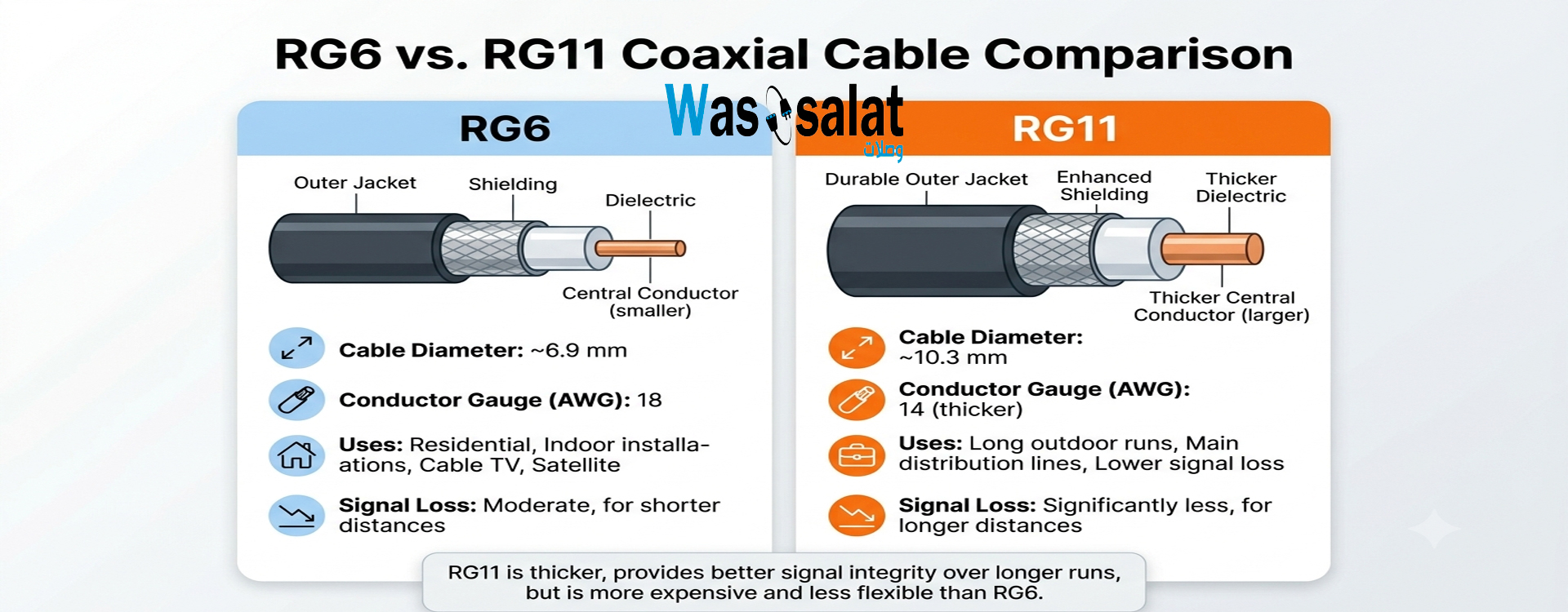
RG6 and RG11 are both 75Ω coaxial cables designed primarily for video and data transmission. They're used in applications ranging from residential TV to professional broadcast installations.
RG6 – The Industry Standard
RG6 is the most common coaxial cable worldwide. It's used in millions of homes for cable TV, satellite TV, and broadband internet connections. RG6 offers an excellent balance of performance, flexibility, and cost.
RG11 – The Long-Distance Champion
RG11 is a thicker, lower-loss cable designed for long cable runs. It's used in commercial installations, large buildings, and anywhere signals need to travel over 150 feet without degradation.
? Quick Answer: Use RG6 for most residential and standard commercial installations. Use RG11 for long cable runs (over 150 feet) or when you need the lowest possible signal loss.
Construction Differences
The physical differences between RG6 and RG11 are significant and directly impact performance.
| Component | RG6 | RG11 |
|---|---|---|
| Center Conductor | 18 AWG (Copper or CCS) | 14 AWG (Thicker) |
| Dielectric (Insulation) | Foam PE (4.57mm) | Foam PE (7.11mm) |
| Shield | Single, Dual, or Quad | Dual or Quad (Thicker) |
| Outer Jacket | PVC or PE (6.9mm diameter) | PVC or PE (10.3mm diameter) |
| Overall Diameter | ~6.9 mm (0.27 inches) | ~10.3 mm (0.41 inches) |
| Weight per 100ft | ~6 lbs | ~14 lbs |
Key Takeaways
- RG11 is significantly thicker and heavier – Approximately 50% larger in diameter
- RG11 has a thicker center conductor – Lower resistance = less signal loss
- RG11 has more dielectric material – Better insulation and lower capacitance
- RG11 is stiffer and harder to bend – Requires larger bend radius
Performance Comparison
The thicker construction of RG11 directly translates to better performance, especially over longer distances.
Signal Loss (Attenuation) Comparison
| Frequency | RG6 (dB/100ft) | RG11 (dB/100ft) | RG11 Advantage |
|---|---|---|---|
| 50 MHz | 1.8 dB | 1.2 dB | 33% less loss |
| 100 MHz | 2.5 dB | 1.6 dB | 36% less loss |
| 400 MHz | 5.2 dB | 3.3 dB | 37% less loss |
| 750 MHz | 6.8 dB | 4.2 dB | 38% less loss |
| 1 GHz | 8.5 dB | 5.4 dB | 36% less loss |
| 1.5 GHz | 10.5 dB | 6.7 dB | 36% less loss |
| 2 GHz | 12.0 dB | 7.8 dB | 35% less loss |
| 3 GHz | 15.0 dB | 9.8 dB | 35% less loss |
Other Performance Metrics
| Metric | RG6 | RG11 |
|---|---|---|
| Impedance | 75Ω | 75Ω |
| Max Frequency | 3 GHz | 3 GHz |
| Return Loss (VSWR) | ≥ 20 dB | ≥ 20 dB |
| Capacitance | ~16 pF/ft | ~14 pF/ft |
| Velocity of Propagation | ~83% | ~85% |
When to Use RG6
RG6 is the default choice for most installations. Here's when to use it:
Residential Applications
- ? Cable TV (CATV) – Standard for connecting cable boxes and TVs
- ? Satellite TV – Dish to receiver connections (quad shield recommended)
- ? Broadband Internet – Cable modem connections
- ? Home Theater – Video distribution throughout the home
Commercial Applications
- ? Office Buildings – CATV and broadband distribution
- ? CCTV Systems – Video surveillance (runs under 150 feet)
- ? Hotels – In-room TV distribution
- ? Schools – Video distribution for classrooms
When RG6 is the Right Choice
- Cable runs under 150 feet – RG6 performs well up to this distance
- Standard home installations – Most homes never need anything more
- Flexibility is important – RG6 is easier to route through walls
- Budget-conscious projects – RG6 is significantly cheaper
- DIY installations – Easier to handle and terminate
✅ Recommendation: For 95% of residential installations, RG6 is the perfect choice. It's affordable, effective, and easy to work with.
When to Use RG11
RG11 is the professional choice for demanding installations. Here's when to use it:
Commercial Applications
- ? Large Buildings – Main distribution lines (risers, trunks)
- ? Hotels & Resorts – Long runs from head-end to guest rooms
- ? Campuses – Between buildings or across large campuses
- ? Satellite Master Antenna TV (SMATV) – Multi-dwelling distribution
Professional Applications
- ? Broadcast Studios – Long video runs
- ? Professional CCTV – Long-distance surveillance
- ? Hospitals – Reliable video distribution
- ? Industrial Facilities – Harsh environment installations
When RG11 is the Right Choice
- Cable runs over 150 feet – RG11's lower loss is essential
- Multiple splitters in the line – Each splitter adds loss; RG11 compensates
- High-frequency signals – RG11 performs better at higher frequencies
- Critical installations – When signal quality is paramount
- Future-proofing – Higher bandwidth capability for future upgrades
⚠️ Note: RG11 is more expensive, harder to install, and requires special connectors. Only use it when RG6 is insufficient.
Maximum Distance Comparison
The maximum distance for a cable run depends on the frequency and the signal quality required.
Recommended Maximum Distances
| Application | RG6 | RG11 |
|---|---|---|
| Cable TV (CATV) – 50-750 MHz | 150-200 ft | 250-350 ft |
| Satellite TV – 950-2150 MHz | 100-150 ft | 200-300 ft |
| Broadband Internet – 5-1000 MHz | 150-200 ft | 250-350 ft |
| CCTV – 0-30 MHz | 200-300 ft | 400-600 ft |
| HD-SDI – 1.5 Gbps | 100-150 ft | 200-300 ft |
| 3G-SDI – 3 Gbps | 50-100 ft | 150-200 ft |
Calculating Your Needs
To determine which cable you need:
- Measure your cable run – Include all walls, ceilings, and bends
- Add 10-15% for service loops – Always add extra length
- Check your frequency – Higher frequencies require lower loss
- Consider splitters – Each splitter adds 3.5 dB loss per port
- If total loss exceeds acceptable levels – Use RG11 or add an amplifier
Cost Comparison
RG11 is significantly more expensive than RG6. Here's what to expect:
| Item | RG6 | RG11 | Cost Difference |
|---|---|---|---|
| Cable (per 500 ft spool) | ~$80 | ~$200 | 2.5x more |
| Connectors (per piece) | ~$0.50-1.00 | ~$2.00-3.50 | 3-4x more |
| Stripping Tool | ~$15 | ~$40 | 2-3x more |
| Installation Time | Standard | 50-75% more | More expensive |
? Cost Tip: While RG11 costs more upfront, it can save money in the long run by avoiding the need for signal amplifiers on long runs.
Installation Considerations
RG11 is more difficult to install than RG6. Here's what you need to know:
Bend Radius
- RG6 – Bend radius of ~2-3 inches
- RG11 – Bend radius of ~4-6 inches (requires more space)
- RG11 cannot make sharp 90-degree turns – Use sweeping bends
Weight and Handling
- RG6 – Lightweight, easy to pull
- RG11 – Heavy (2x RG6), requires more effort to pull
- RG11 may need pulleys or conduit – For long vertical runs
Connector Installation
- RG6 – Standard F-Type compression connectors work
- RG11 – Requires larger connectors (different size)
- RG11 needs specialized tools – Cannot use standard RG6 tools
Conduit Requirements
- RG6 – Fits in standard 1/2" conduit
- RG11 – Often requires 3/4" or 1" conduit
- RG11 uses more conduit space – Plan accordingly
⚠️ Warning: Don't try to use RG6 connectors on RG11 cable. They won't fit, and forcing them will damage the cable.
Connector Requirements
RG6 and RG11 require different connectors. Here's what to use:
RG6 Connectors
- F-Type – Standard for TV and satellite (most common)
- BNC (75Ω) – For video equipment and CCTV
- RCA – Consumer video connections
- Connector size – Standard 6.9mm (0.27") diameter
RG11 Connectors
- F-Type (RG11 size) – Larger barrel for thick cable
- BNC (75Ω, RG11 size) – Professional video equipment
- Connector size – 10.3mm (0.41") diameter
- Requires RG11-specific connectors – Not interchangeable
Identifying Connectors
| Feature | RG6 Connector | RG11 Connector |
|---|---|---|
| Barrel Size | Small (6.9mm) | Large (10.3mm) |
| Center Pin | Standard 18 AWG | Thicker 14 AWG |
| Compression Type | Standard | Heavy-duty |
| Color Marking | Often Blue or Clear | Often Red or Black |
Side-by-Side Comparison Table
| Feature | RG6 | RG11 |
|---|---|---|
| Impedance | 75Ω | 75Ω |
| Center Conductor Size | 18 AWG | 14 AWG |
| Overall Diameter | 6.9 mm | 10.3 mm |
| Attenuation @ 100 MHz | 2.5 dB/100ft | 1.6 dB/100ft |
| Attenuation @ 1 GHz | 8.5 dB/100ft | 5.4 dB/100ft |
| Max Recommended Length | 150-200 ft | 250-350 ft |
| Cost (per 500ft) | ~$80 | ~$200 |
| Installation Difficulty | Easy | Challenging |
| Connector Type | Standard F-Type | RG11 F-Type |
| Best For | Residential | Commercial/Long Distance |
Frequently Asked Questions (FAQ)
1. What's the main difference between RG6 and RG11?
RG11 has a thicker center conductor (14 AWG vs 18 AWG) and larger overall diameter, which provides lower signal loss over longer distances. RG6 is thinner, more flexible, and less expensive.
2. Can I use RG6 for a 200-foot run?
It depends on the frequency. For cable TV (under 750 MHz), RG6 can work at 200 feet, but you may need an amplifier. For satellite TV (1-2 GHz), RG6 is limited to about 150 feet. RG11 is recommended for runs over 150 feet.
3. Can I use RG11 connectors on RG6 cable?
No. RG11 connectors are larger and won't fit RG6 cable. You must use the correct connector for each cable type.
4. Is RG11 better than RG6?
RG11 performs better over long distances but is overkill for most residential installations. "Better" depends on your specific needs—distance, frequency, and budget.
5. How far can I run RG6 for satellite TV?
For satellite TV (950-2150 MHz), RG6 is typically limited to 100-150 feet. For runs longer than that, use RG11 or add a signal amplifier.
6. How far can I run RG11 for cable TV?
RG11 can handle cable TV signals (50-750 MHz) up to 250-350 feet without significant signal degradation.
7. Is RG11 worth the extra cost?
Yes, for long runs or commercial installations. For standard home installations under 150 feet, RG6 is more cost-effective.
8. Can I run RG11 and RG6 together?
Yes, you can use RG11 for the main trunk line and RG6 for shorter drops. Just use proper connectors and splitters.
9. What connectors do I need for RG11?
You need RG11-specific connectors. F-Type connectors for RG11 have a larger barrel, and BNC connectors for RG11 are also larger.
10. Is RG11 harder to install than RG6?
Yes. RG11 is stiffer, heavier, and requires larger bend radius, larger conduit, and different tools. Installation takes 50-75% longer.
11. Which cable is better for CCTV?
For runs under 200 feet, RG6 is fine. For runs over 200 feet, RG11 provides better video quality with less signal loss.
12. Can RG6 do 4K video?
Yes, RG6 can handle 4K video signals when using proper connectors and short-to-medium runs. For longer runs, RG11 is recommended.
? Related Articles
- Complete Guide to Coaxial Cables
- 50 Ohm vs 75 Ohm Coax
- RG58 vs RG59
- Coaxial Cable Connectors Guide
- Cable Attenuation Explained
- Browse Coaxial Cables →
? Need RG6 or RG11 Coaxial Cables?
We stock high-quality RG6 and RG11 cables for all applications—from residential TV to commercial installations. Choose from standard, plenum, outdoor, and quad-shield options.
Last Updated: July 2026
© 2026 Wassalat. All rights reserved.
Posted in:
Coaxial Cables
Related posts
-
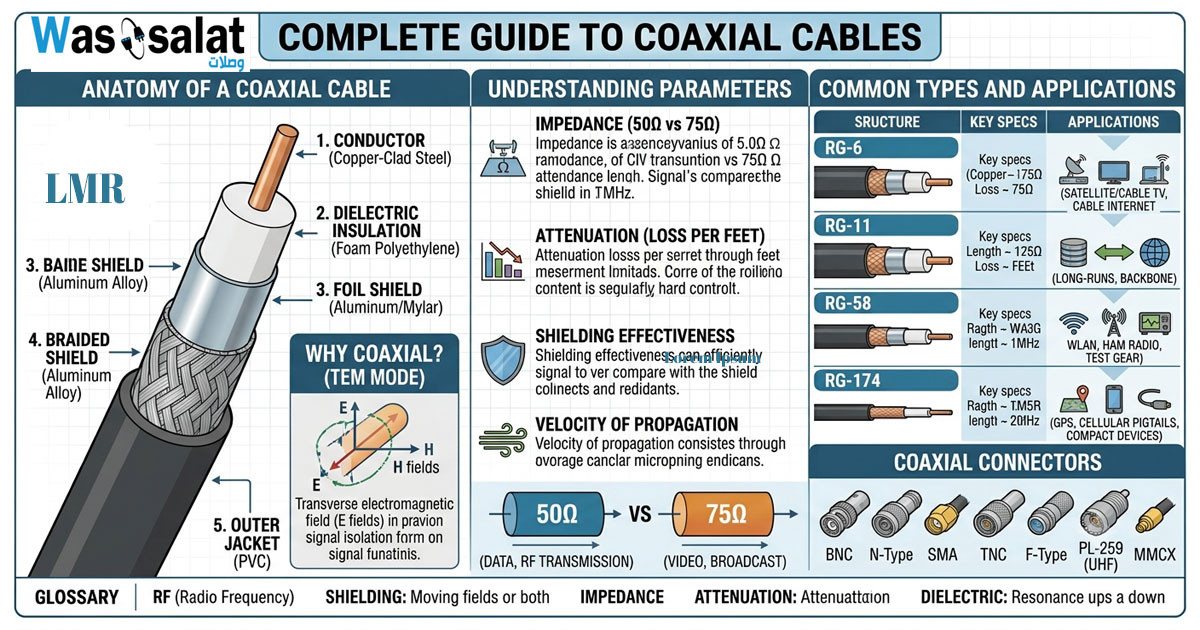 Complete Guide to Coaxial Cables
Everything you need to know about RG-6, LMR-400, impedance, connectors & troubleshooting.Read more
Complete Guide to Coaxial Cables
Everything you need to know about RG-6, LMR-400, impedance, connectors & troubleshooting.Read more -
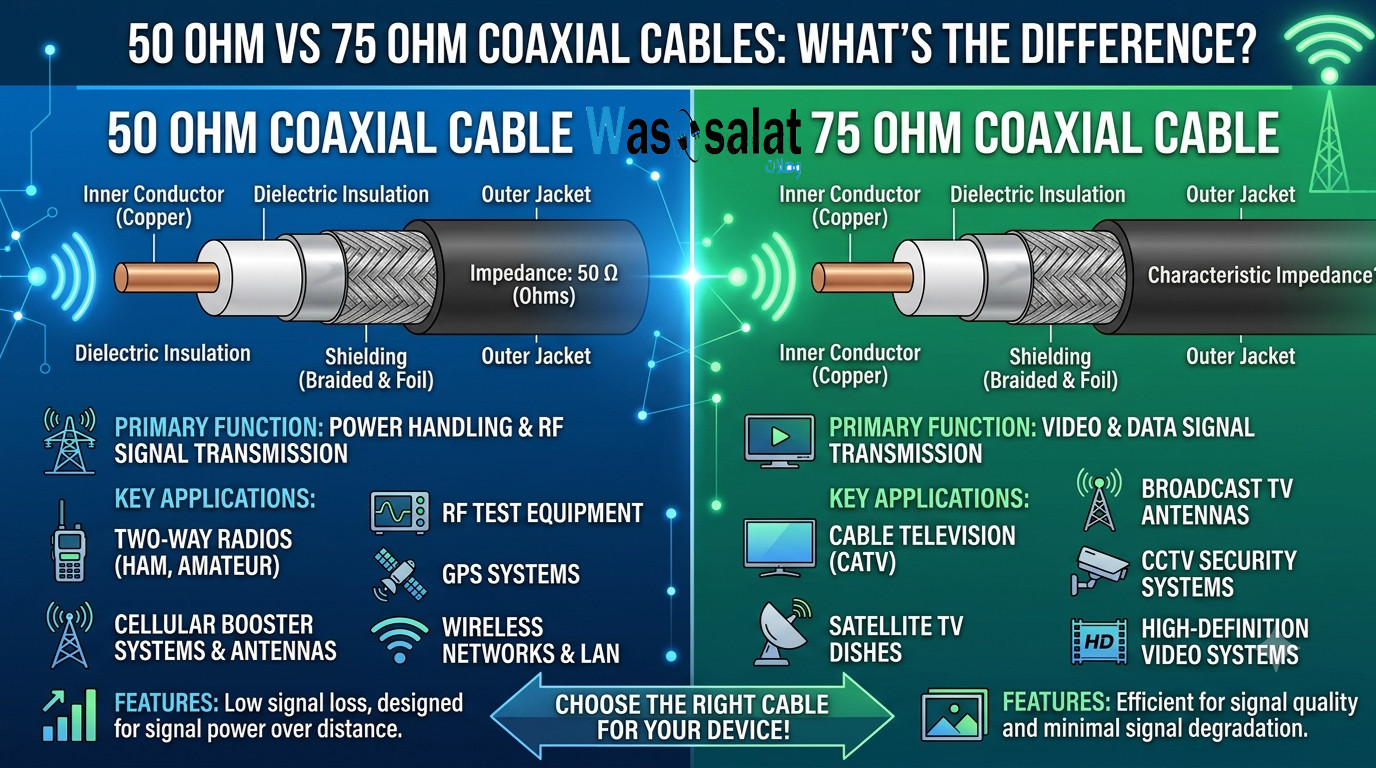 50 Ohm vs 75 Ohm Coaxial Cables: What's the Difference?
Learn the key differences between 50Ω and 75Ω coaxial cables. Find out which impedance you need for WiFi, TV, CCTV,...Read more
50 Ohm vs 75 Ohm Coaxial Cables: What's the Difference?
Learn the key differences between 50Ω and 75Ω coaxial cables. Find out which impedance you need for WiFi, TV, CCTV,...Read more -
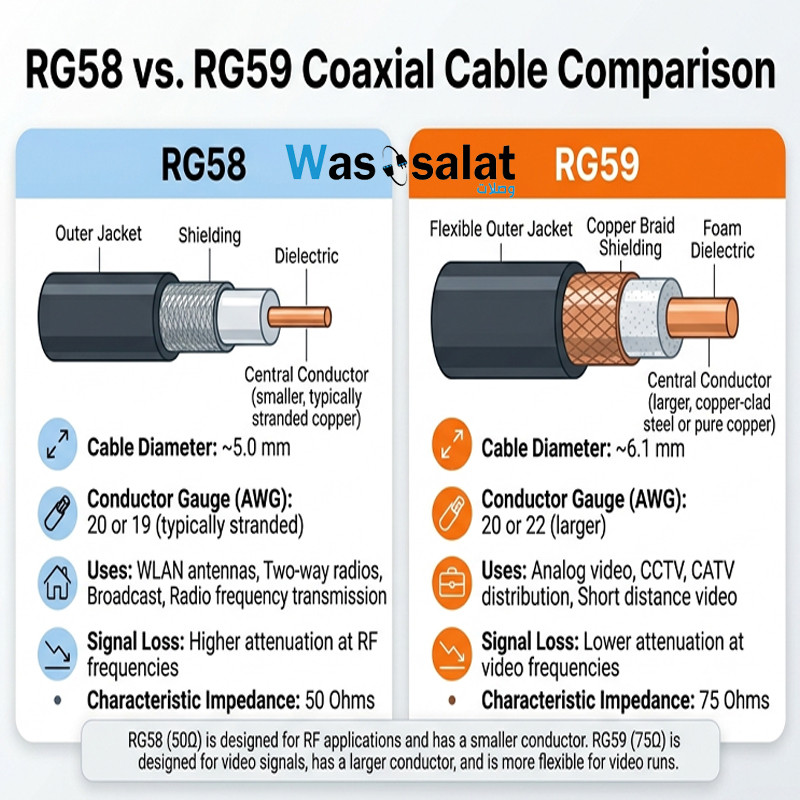 RG58 vs RG59 Coaxial Cables: What's the Difference?
Compare RG58 and RG59 coaxial cables. Learn the critical impedance difference, applications for RF vs video, and...Read more
RG58 vs RG59 Coaxial Cables: What's the Difference?
Compare RG58 and RG59 coaxial cables. Learn the critical impedance difference, applications for RF vs video, and...Read more -
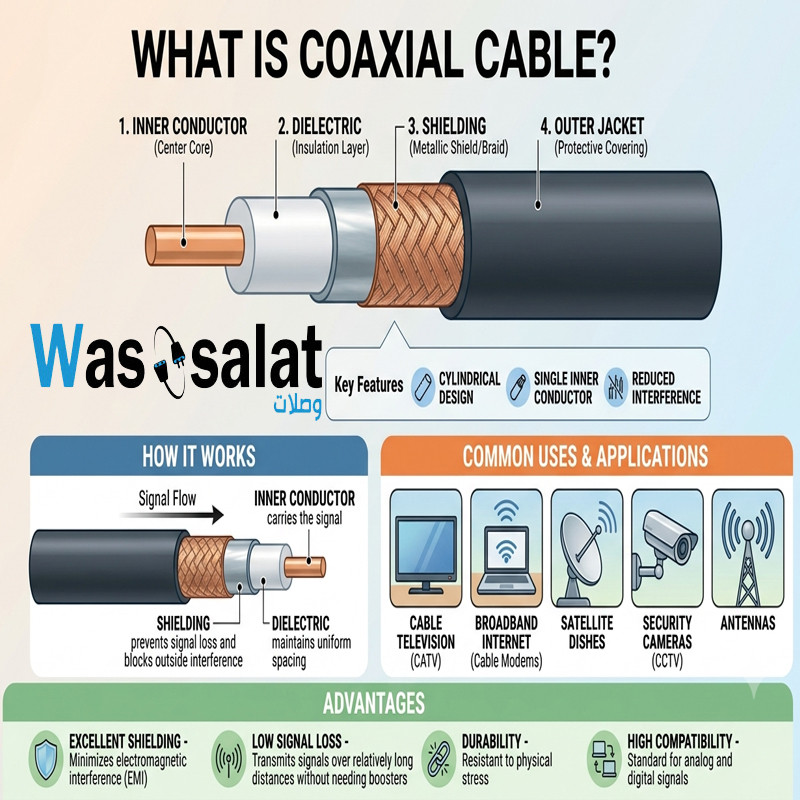 What Is a Coaxial Cable? The Complete Beginner's Guide
Learn what coaxial cables are, how they work, their construction, types, and applications. The beginner's guide to...Read more
What Is a Coaxial Cable? The Complete Beginner's Guide
Learn what coaxial cables are, how they work, their construction, types, and applications. The beginner's guide to...Read more -
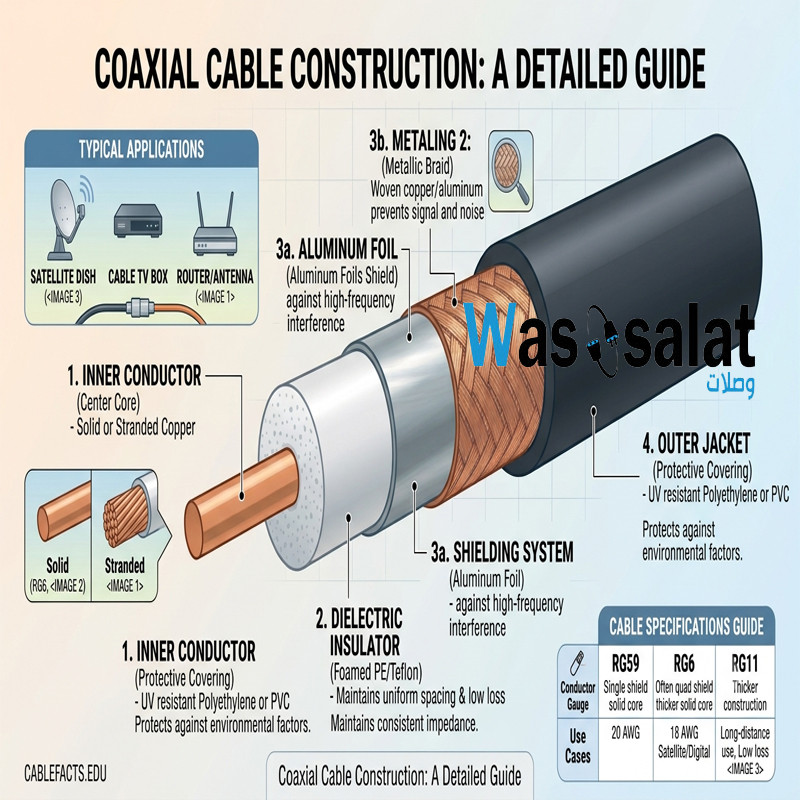 Coaxial Cable Construction: A Complete Layer-by-Layer Breakdown
Learn how coaxial cables are constructed. Understand each layer—conductor, dielectric, shield, and jacket—and how...Read more
Coaxial Cable Construction: A Complete Layer-by-Layer Breakdown
Learn how coaxial cables are constructed. Understand each layer—conductor, dielectric, shield, and jacket—and how...Read more
Latest posts
-
 Waterproof Coaxial Cable: The Complete GuideRead more
 -
 Testing Coaxial Cable: The Complete GuideRead more
This comprehensive guide covers everything you need to know about testing coaxial cable—from simple continuity checks...
-
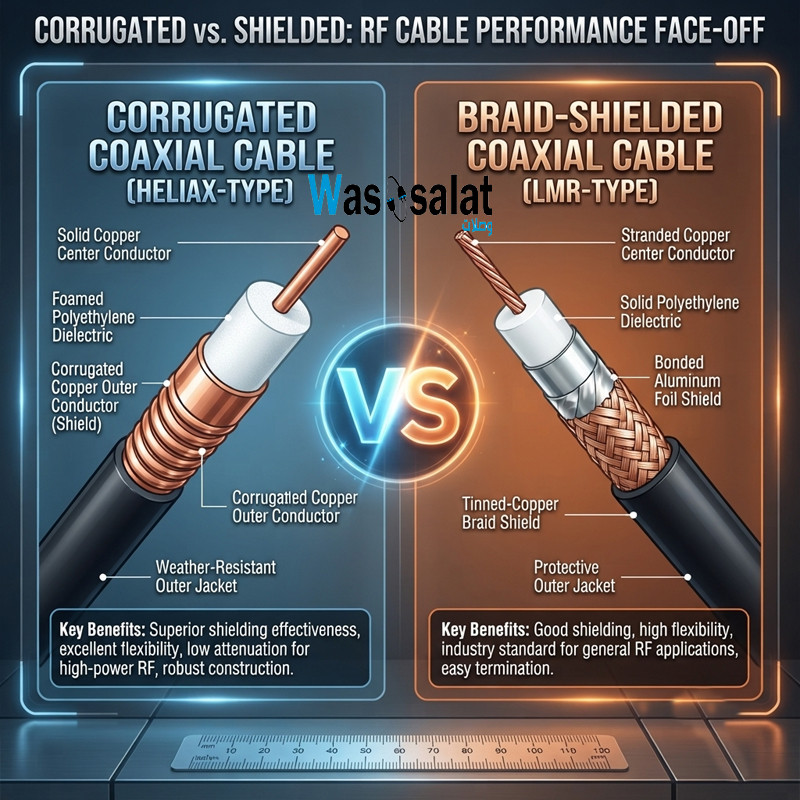 Corrugated Coaxial Cable vs Shielded Coaxial Cable: Complete ComparisonRead more
This comprehensive guide compares both technologies—explaining the differences in construction, performance,...
-
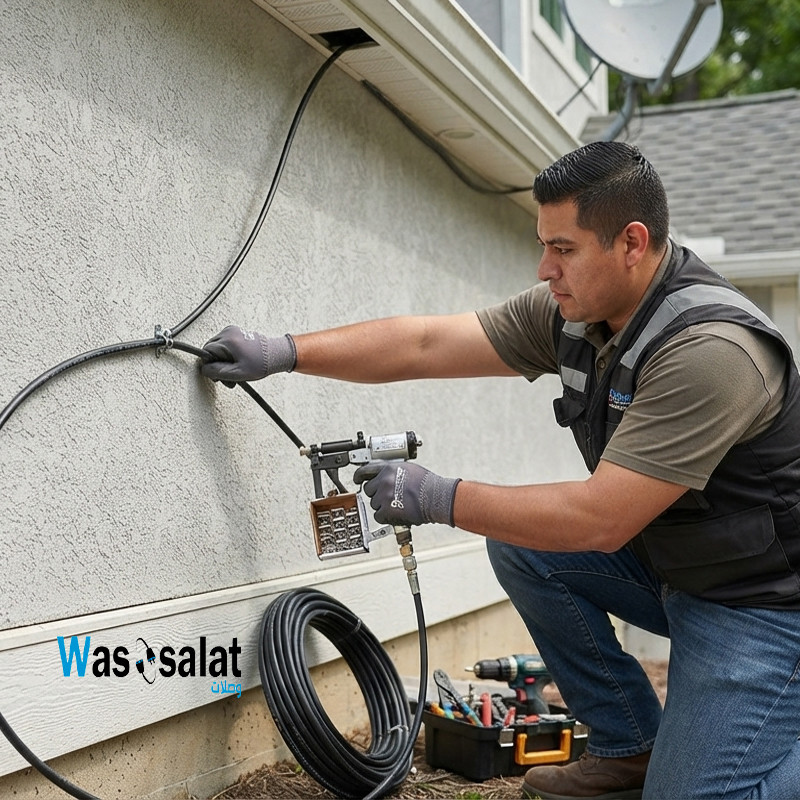 Installing Coaxial Cable: The Complete GuideRead more
This comprehensive guide compares double shield and quad shield coaxial cables—explaining the differences in...
-
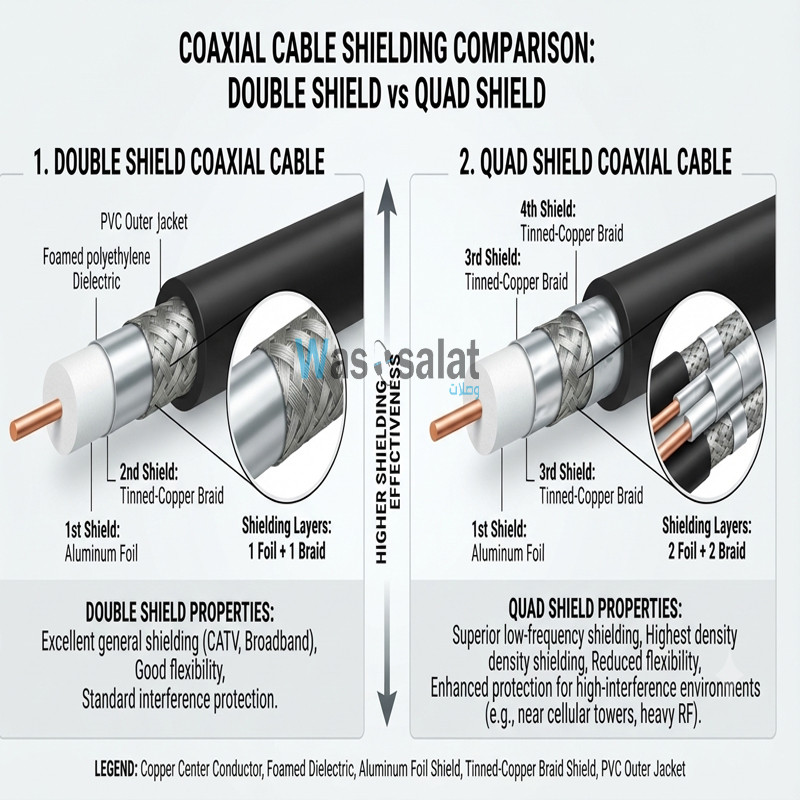 Double Shield vs Quad Shield: Which Coaxial Cable Should You Choose?Read more
This comprehensive guide compares double shield and quad shield coaxial cables—explaining the differences in...
-
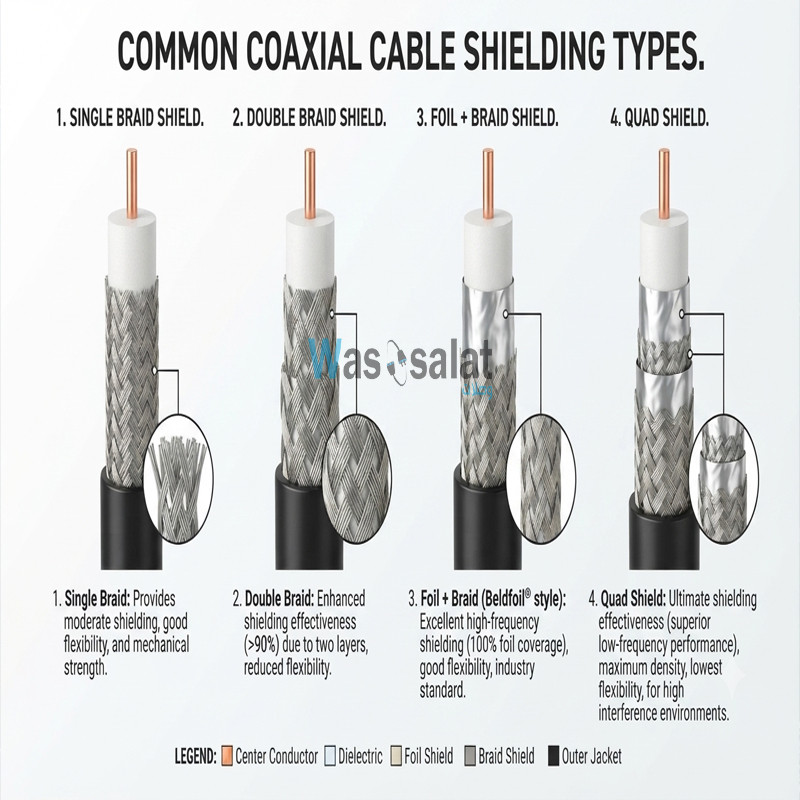 Shielding Types in Coaxial Cables: Complete GuideRead more
This comprehensive guide explains everything you need to know about shielding types—from single shield to quad...
-
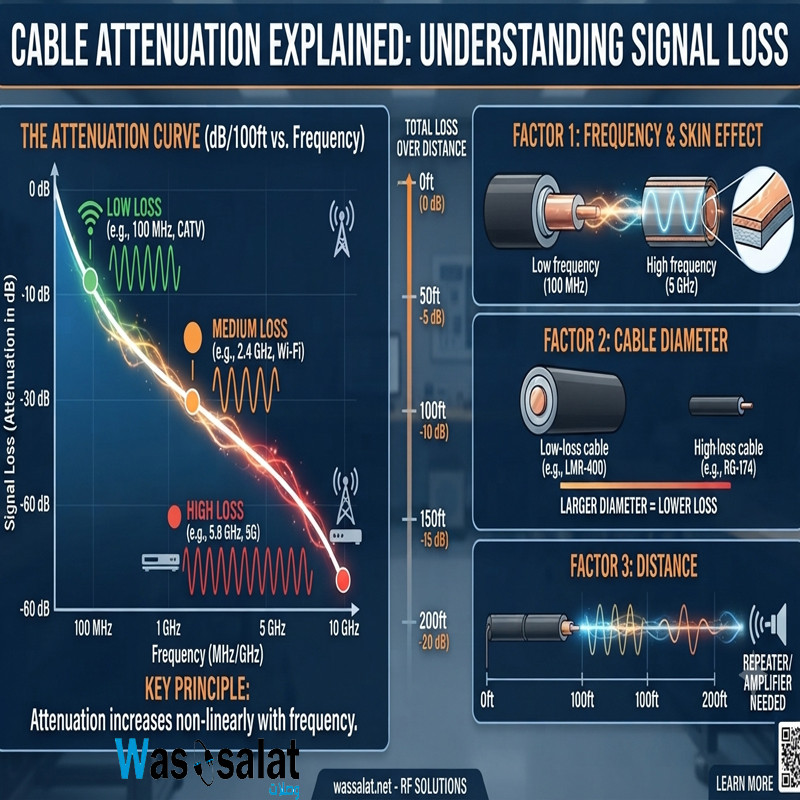 Cable Attenuation Explained: Understanding Signal LossRead more
This comprehensive guide explains everything you need to know about cable attenuation—what it is, what causes it, how...
-
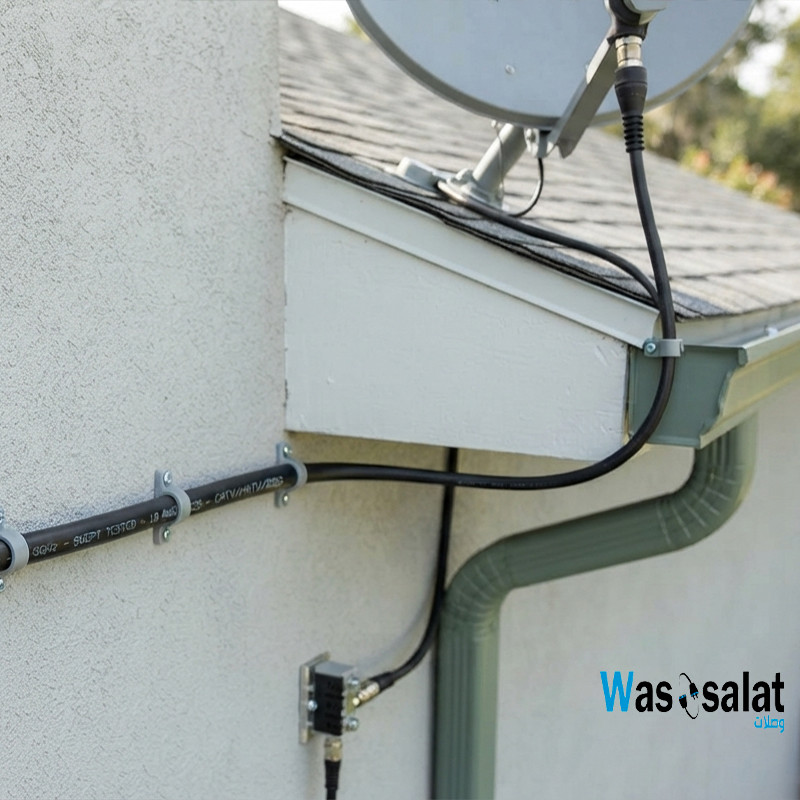 Outdoor Coaxial Cable: Complete Guide & Selection TipsRead more
Choose the right outdoor coaxial cable for your installation. Compare TZC-500/32 vs TZC-500/97, learn about PE...
-
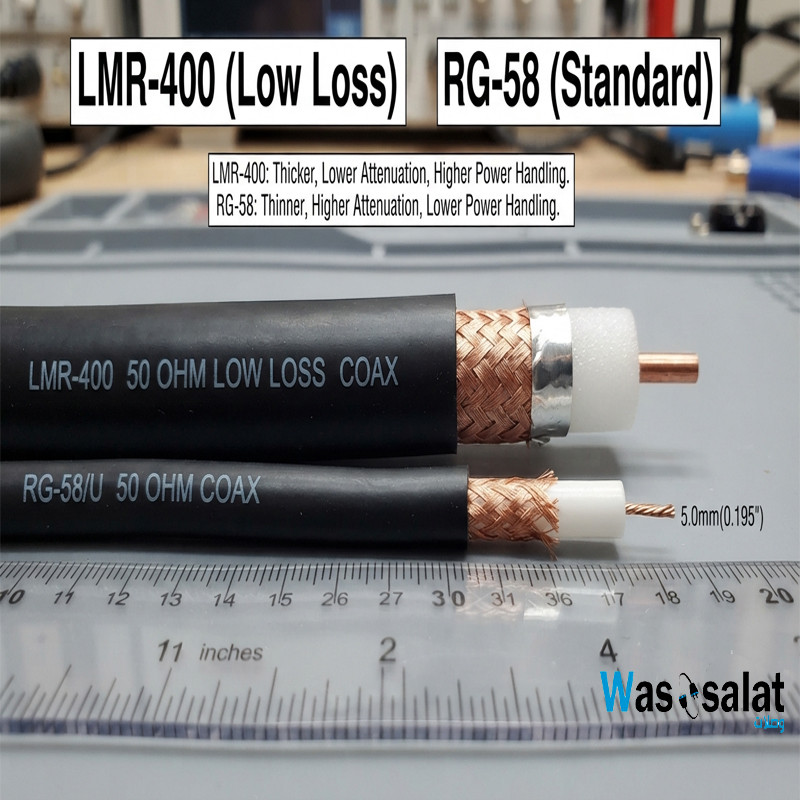 LMR-400 vs RG58: Which Coaxial Cable Should You Choose?Read more
Compare LMR-400 vs RG58 coaxial cables. Learn the differences in signal loss, construction, flexibility, and...
-
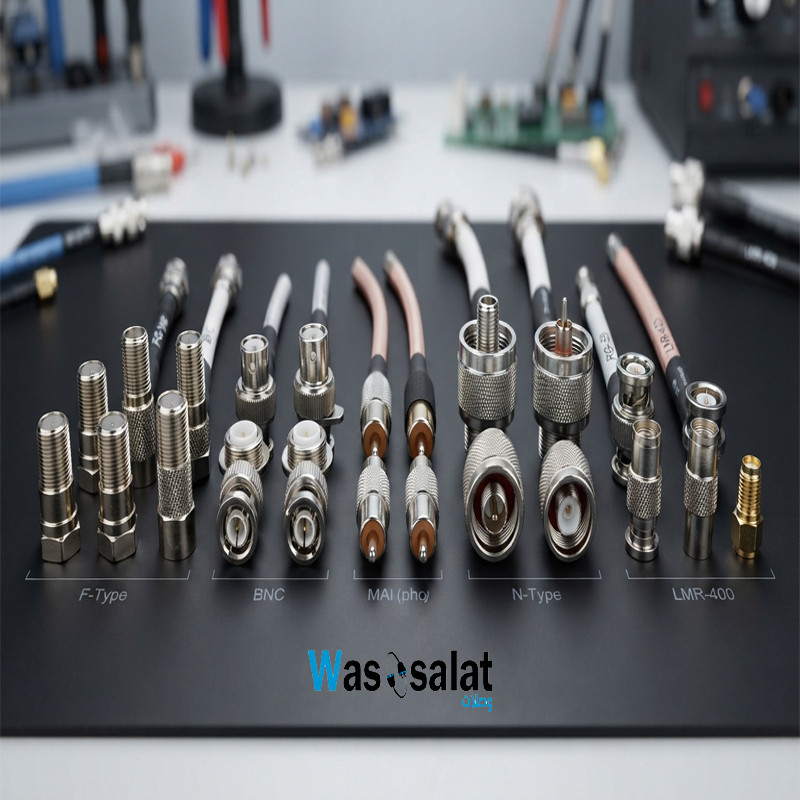 Coax Cable Connectors: Complete Guide to F-Type, BNC, N-Type, SMARead more
Learn about coaxial cable connectors—F-Type, BNC, N-Type, SMA, TNC, and UHF. Compare impedances, frequencies, and...
Leave a comment