

This comprehensive guide covers everything you need to know about waterproof coaxial cables—from understanding water...
What Is a Coaxial Cable? The Complete Beginner's Guide
What Is a Coaxial Cable? The Complete Beginner's Guide
Published by Wassalat Technical Team
If you've ever connected a TV antenna, set up a cable modem, installed a security camera, or used a radio, you've encountered a coaxial cable. But what exactly is it, and why is it so important?
This beginner-friendly guide explains everything you need to know about coaxial cables—what they are, how they work, what they're used for, and why they've been the backbone of communications for nearly a century.
? Table of Contents
- What Is a Coaxial Cable?
- Why Is It Called "Coaxial"?
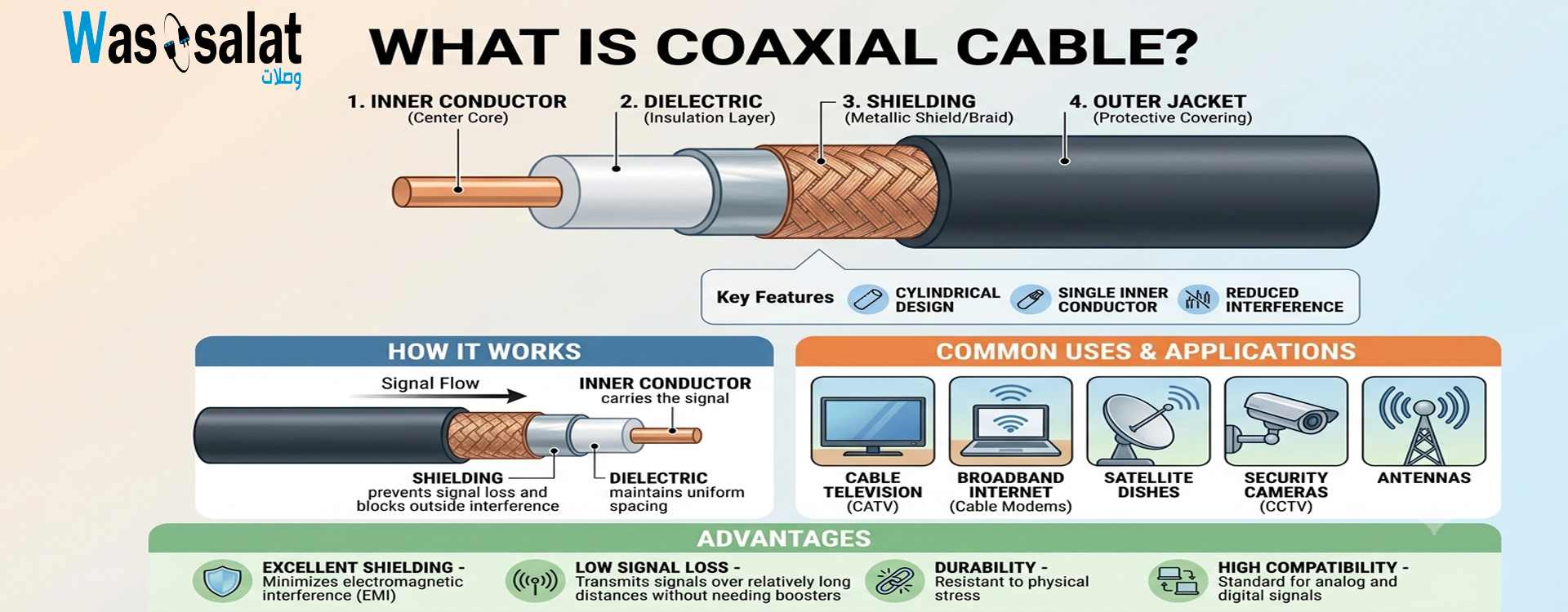
- How Is a Coaxial Cable Constructed?
- How Does a Coaxial Cable Work?
- Common Types of Coaxial Cables
- What Are Coaxial Cables Used For?
- Advantages of Coaxial Cables
- Disadvantages of Coaxial Cables
- Coax vs Other Cable Types
- A Brief History
- Frequently Asked Questions
What Is a Coaxial Cable?
A coaxial cable (often called "coax" for short) is a type of electrical cable that transmits high-frequency signals with minimal interference and signal loss.
It consists of a central conductor surrounded by an insulating layer, a metallic shield, and an outer protective jacket. All these layers share the same center axis—hence the name "co-axial."
Coaxial cables are used to transmit:
- ? Radio frequency (RF) signals
- ? Video and television signals
- ? Internet data (cable broadband)
- ? CCTV and surveillance video
- ? Satellite communications
- ? Radio communications
? Simple Definition: A coaxial cable is like a protected highway for signals. The center conductor carries the signal, and the shield protects it from interference—just like a highway has lanes for traffic and barriers to keep out unwanted vehicles.
Why Is It Called "Coaxial"?
The term "coaxial" comes from the words "co" (together) and "axial" (axis).
In a coaxial cable, all layers share the same centerline or axis. The inner conductor, the dielectric insulation, the shield, and the outer jacket are all perfectly centered around the same imaginary line running through the middle of the cable.
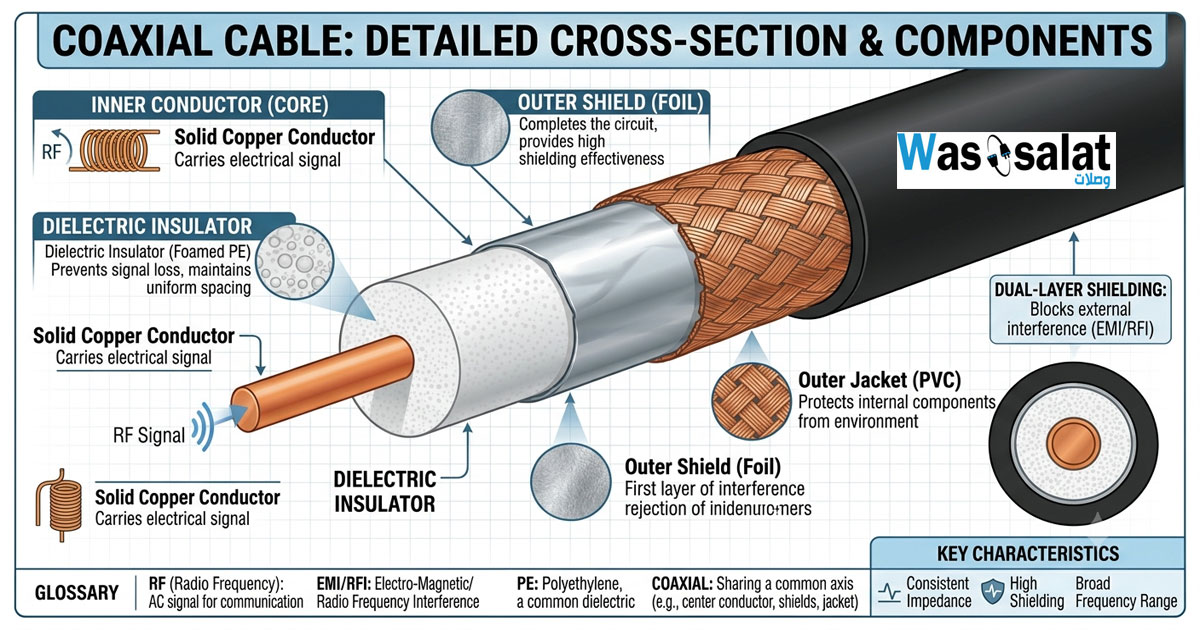
This unique construction is what gives coaxial cables their excellent performance. The symmetrical design ensures that the signal travels efficiently and is protected from external interference.
How Is a Coaxial Cable Constructed?
Every coaxial cable consists of four main layers, each with a specific purpose:
1. Center Conductor (Inner Core)
Material: Solid copper, copper-clad steel (CCS), or copper-clad aluminum (CCA)
Function: Carries the electrical signal from the source to the destination
Size: Measured in AWG (American Wire Gauge) – lower number = thicker wire
2. Dielectric Insulation
Material: Polyethylene (PE), foam polyethylene, or PTFE (Teflon)
Function: Keeps the center conductor separated from the shield
Key Property: Determines the cable's impedance and signal speed
3. Metallic Shield
Material: Copper braid, aluminum foil, or solid copper tube
Function: Blocks external electromagnetic interference (EMI)
Coverage: Measured as percentage (higher = better protection)
4. Outer Jacket
Material: PVC, polyethylene (PE), or plenum-rated fire retardant
Function: Protects the cable from physical damage, moisture, and UV rays
Color: Often black (outdoor), white (indoor), or blue (specialized)
| Layer | Material | Function |
|---|---|---|
| Center Conductor | Copper, CCS, or CCA | Carries the signal |
| Dielectric Insulation | PE, Foam PE, PTFE | Separates conductor from shield |
| Metallic Shield | Copper Braid, Foil | Blocks interference |
| Outer Jacket | PVC, PE, Plenum | Protects against damage |
How Does a Coaxial Cable Work?
Coaxial cables transmit signals using electromagnetic wave propagation. Here's the step-by-step process:
Transmission Process
- Signal Input – An electrical signal enters the cable through the center conductor.
- Wave Propagation – The signal travels as electromagnetic waves along the conductor.
- Shielding Protection – The metallic shield blocks external electromagnetic interference (EMI) from entering the cable.
- Signal Integrity – The dielectric insulation maintains the signal's electrical properties.
- Signal Output – The signal exits the cable at the receiving device with minimal loss.
Key Physics Principles
- Skin Effect – High-frequency signals travel on the surface of the conductor
- Impedance Matching – The cable's impedance must match the equipment's impedance
- Signal Propagation – Signals travel at the speed of light (reduced by the dielectric)
- Attenuation – Signals lose strength over distance (measured in dB)
Common Types of Coaxial Cables
There are many types of coaxial cables. Here are the most common:
RG-6
Impedance: 75Ω
Primary Use: Cable TV, Satellite TV, Broadband Internet
Key Feature: Most common coax cable. Good for runs up to 150 feet.
RG-59
Impedance: 75Ω
Primary Use: Short-distance CCTV, Analog Video
Key Feature: Thin and flexible. Best for runs under 100 feet.
RG-11
Impedance: 75Ω
Primary Use: Long-distance video, Main trunk lines
Key Feature: Thick and low-loss. For runs over 150 feet.
RG-58
Impedance: 50Ω
Primary Use: RF test equipment, Radio communications
Key Feature: Flexible, low cost, short runs.
LMR-400
Impedance: 50Ω
Primary Use: Wireless networks, WISP, Antenna feeds
Key Feature: Very low loss, excellent for RF.
| Cable Type | Impedance | Primary Use | Max Length |
|---|---|---|---|
| RG-6 | 75Ω | TV, Satellite, Internet | 150 ft |
| RG-59 | 75Ω | CCTV, Short Video | 100 ft |
| RG-11 | 75Ω | Long Video Runs | 300 ft |
| RG-58 | 50Ω | RF, Radio, Test | 50 ft |
| LMR-400 | 50Ω | Wireless, Antennas | 300 ft |
What Are Coaxial Cables Used For?
Coaxial cables are used in countless applications across many industries:
Residential Applications
- ? Cable Television (CATV) – Connecting TVs to cable providers
- ? Satellite TV – Dish to receiver connections
- ? Broadband Internet – Cable modem connections
- ? Home Theater – Video and audio distribution
- ? Security Cameras – Analog CCTV systems
Commercial Applications
- ? Office Buildings – Video and data distribution
- ? Hotels – In-room TV and internet
- ? Schools – Video distribution for classrooms
- ? Hospitals – Medical video and data transmission
- ? Industrial – Control and monitoring systems
Telecommunications
- ? Base Stations – Cellular and wireless infrastructure
- ? Radio Stations – Broadcast and studio connections
- ? Microwave Links – Point-to-point communication
- ?️ Satellite Ground Stations – Earth station connections
Broadcast & Professional
- ? Television Studios – Video production and routing
- ? Live Events – Camera and video distribution
- ? Post-Production – Video editing and mastering
Advantages of Coaxial Cables
Coaxial cables have been the standard for decades for good reason:
1. Excellent Shielding
The metallic shield provides superior protection against electromagnetic interference (EMI) and radio frequency interference (RFI). This means clearer signals and fewer errors.
2. High Bandwidth
Coaxial cables can carry high-frequency signals over long distances. Modern coax can handle frequencies up to 3 GHz or more.
3. Relatively Low Cost
Compared to fiber optic cables, coaxial cables are significantly less expensive while still providing excellent performance.
4. Easy to Install
Coaxial cables are relatively easy to install and terminate. Connectors like F-Type and BNC are simple to attach with basic tools.
5. Durable
The outer jacket and shield protect the cable from physical damage, moisture, and environmental factors.
6. Versatile
Coax is used for video, data, RF, and many other applications. One cable type can handle multiple signal types.
7. Long Distance
Depending on the type, coaxial cables can transmit signals over hundreds of feet without significant loss.
Disadvantages of Coaxial Cables
While coaxial cables are excellent for many applications, they have some limitations:
1. Signal Loss
Coaxial cables experience signal loss (attenuation) over distance. Loss increases with frequency and cable length.
2. Susceptibility to Moisture
If the outer jacket is damaged, moisture can enter the cable and cause signal degradation or failure.
3. Thickness
Coaxial cables can be thick and stiff, making them harder to route in tight spaces.
4. Limited Distance
While coax can go hundreds of feet, fiber optic cables can go much farther (kilometers).
5. Impedance Matching Required
All equipment in a coax system must have matching impedance (50Ω or 75Ω). Mismatches cause signal loss.
Coax vs Other Cable Types
How does coaxial cable compare to other common cable types?
Coax vs Fiber Optic
| Feature | Coaxial | Fiber Optic |
|---|---|---|
| Speed | Good (up to 10 Gbps) | Excellent (100+ Gbps) |
| Distance | Limited (hundreds of feet) | Very Long (miles) |
| Interference | Vulnerable (EMI/RFI) | Immune |
| Cost | Low | High |
| Installation | Easy | Complex |
Coax vs Ethernet (Twisted Pair)
| Feature | Coaxial | Ethernet |
|---|---|---|
| Impedance | 50Ω or 75Ω | 100Ω |
| Max Frequency | 3 GHz+ | 500 MHz (Cat6A) |
| Primary Use | RF, Video, Broadband | Data Networks |
| Max Distance | 300+ ft | 328 ft (100m) |
A Brief History of Coaxial Cables
Coaxial cables have a rich history spanning nearly 150 years:
1880 – The First Coax
Oliver Heaviside patented the first coaxial cable design in 1880. He recognized that a cable with a central conductor and a concentric shield would reduce signal loss.
1929 – First Commercial Use
AT&T began using coaxial cables for long-distance telephone transmission. The first commercial system connected New York and Philadelphia.
1936 – Television Transmission
The BBC used coaxial cable to transmit television signals from the 1936 Berlin Olympics. This demonstrated coax's ability to carry video signals.
1940s – RG Designations
The US military introduced the RG (Radio Guide) standard for classifying coaxial cables. RG-8, RG-58, and RG-59 became industry standards.
1970s – Cable Television Boom
Coaxial cables enabled the expansion of cable television across America. By the 1980s, most homes had coax for TV.
1990s – Broadband Internet
Coax became the backbone of broadband internet through cable modems, bringing high-speed internet to millions of homes.
Today – Still Going Strong
Coaxial cables are still essential for satellite TV, cable internet, CCTV, and RF applications. They coexist with fiber optic and Ethernet cables.
Frequently Asked Questions (FAQ)
1. What does "coaxial" mean?
"Coaxial" means "sharing the same axis." In a coaxial cable, the center conductor and outer shield share the same centerline.
2. Why is coaxial cable better than standard wire?
Coaxial cables have superior shielding that prevents interference. They can carry high-frequency signals over longer distances with less loss than standard wires.
3. What is the difference between 50Ω and 75Ω coax?
50Ω coax is used for RF and wireless applications. 75Ω coax is used for video and data transmission. They are not interchangeable.
4. Can I use coaxial cable for internet?
Yes. Coaxial cable is used for cable internet (DOCSIS) and can deliver speeds of 1 Gbps or more.
5. How long can a coaxial cable run?
It depends on the cable type and frequency. RG-6 can run 150-200 feet for TV. LMR-400 can run 300+ feet for RF.
6. Can I bend coaxial cable?
Yes, but avoid sharp bends. Most coax has a minimum bend radius of 6-10 times the cable diameter.
7. What is the most common coaxial cable?
RG-6 is the most common coaxial cable worldwide. It's used for TV, satellite, and broadband internet.
8. What is quad-shield coaxial cable?
Quad-shield cable has four layers of shielding (two foil + two braid) for maximum protection against interference.
9. Can coaxial cable carry power?
Yes. Some systems use coax to carry both signal and power. This is common in satellite TV and CCTV systems.
10. Why does my coax connector have a "center pin"?
The center pin connects to the cable's center conductor. It carries the signal from the cable to the device.
11. What's the difference between RG-6 and RG-59?
RG-6 has a thicker center conductor and can carry signals farther than RG-59. RG-59 is thinner and more flexible.
12. Can I join two coaxial cables together?
Yes, using a barrel connector or coupler. For best performance, use a single continuous cable when possible.
? Related Articles
- Complete Guide to Coaxial Cables
- 50 Ohm vs 75 Ohm Coax
- RG6 vs RG11
- RG58 vs RG59
- Coaxial Cable Construction
- Coaxial Cable Connectors Guide
- Browse Coaxial Cables →
? Shop High-Quality Coaxial Cables
We stock professional coaxial cables for every application—from residential TV to commercial broadcast and wireless installations.
Last Updated: July 2026
© 2026 Wassalat. All rights reserved.
Posted in:
Coaxial Cables
Related posts
-
 Complete Guide to Coaxial Cables
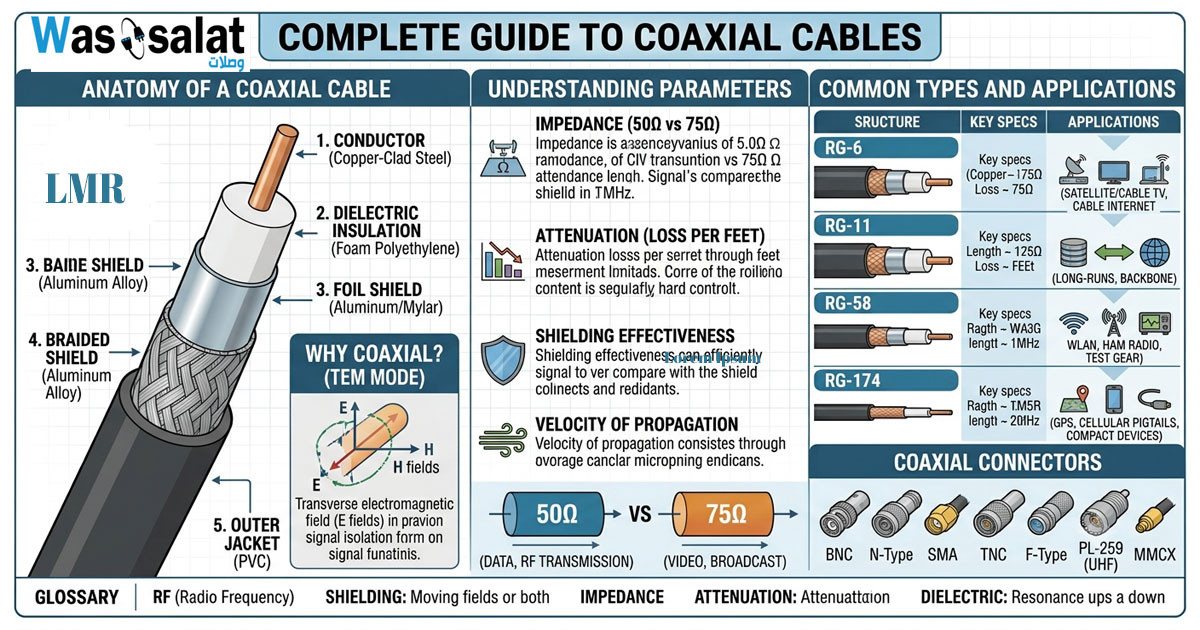
Everything you need to know about RG-6, LMR-400, impedance, connectors & troubleshooting.Read more
Complete Guide to Coaxial Cables
Everything you need to know about RG-6, LMR-400, impedance, connectors & troubleshooting.Read more -
 50 Ohm vs 75 Ohm Coaxial Cables: What's the Difference?
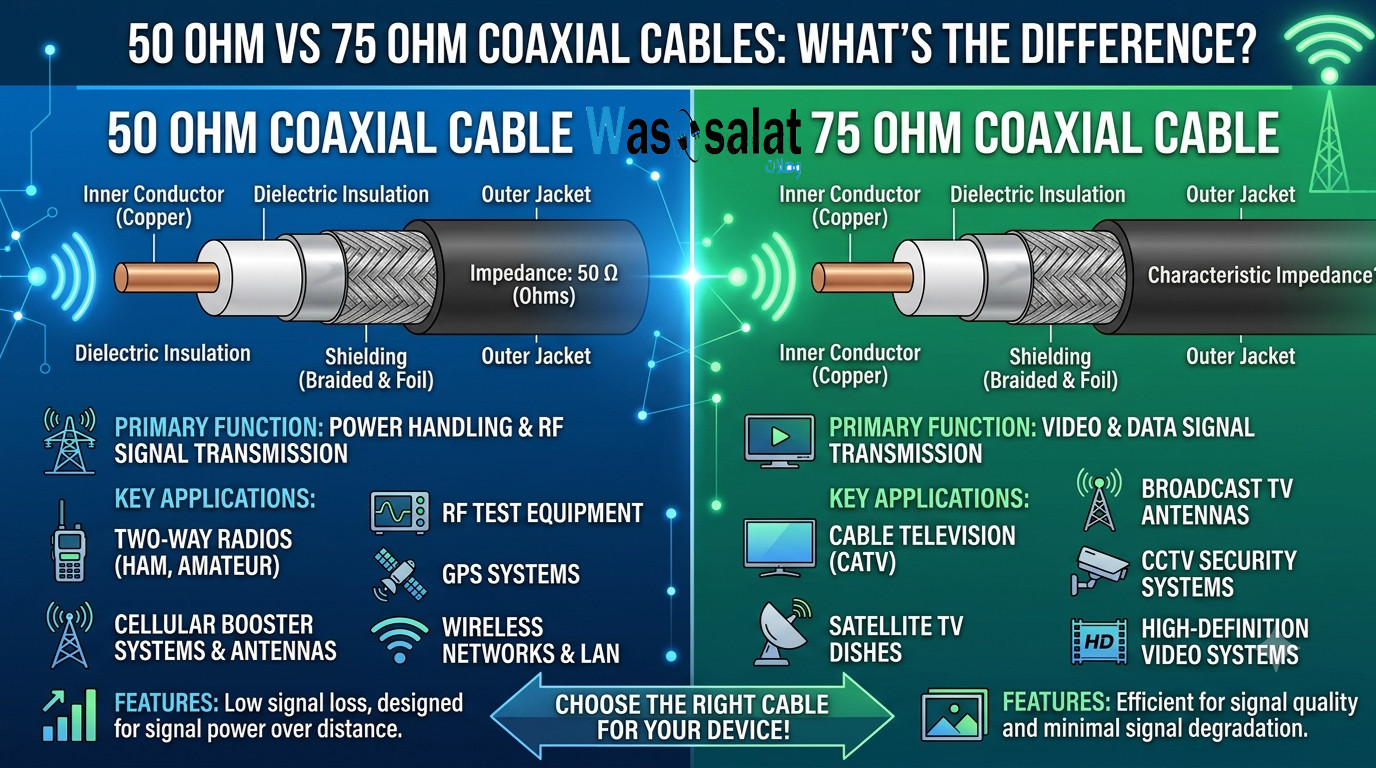
Learn the key differences between 50Ω and 75Ω coaxial cables. Find out which impedance you need for WiFi, TV, CCTV,...Read more
50 Ohm vs 75 Ohm Coaxial Cables: What's the Difference?
Learn the key differences between 50Ω and 75Ω coaxial cables. Find out which impedance you need for WiFi, TV, CCTV,...Read more -
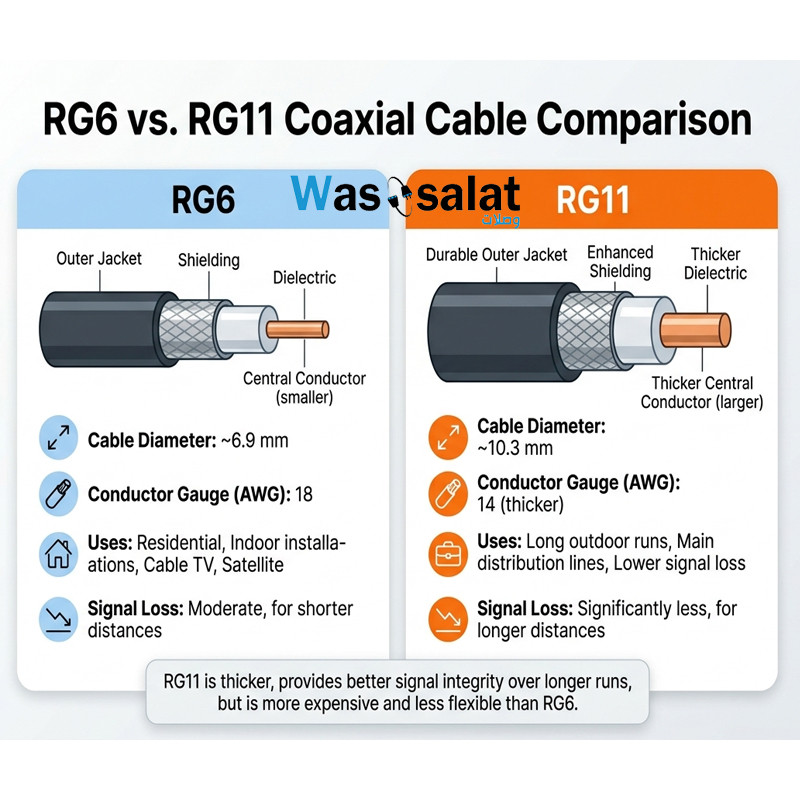 RG6 vs RG11 Coaxial Cables: Which One Do You Need?
Compare RG6 and RG11 coaxial cables. Learn the differences in performance, distance, cost, and when to use each for...Read more
RG6 vs RG11 Coaxial Cables: Which One Do You Need?
Compare RG6 and RG11 coaxial cables. Learn the differences in performance, distance, cost, and when to use each for...Read more -
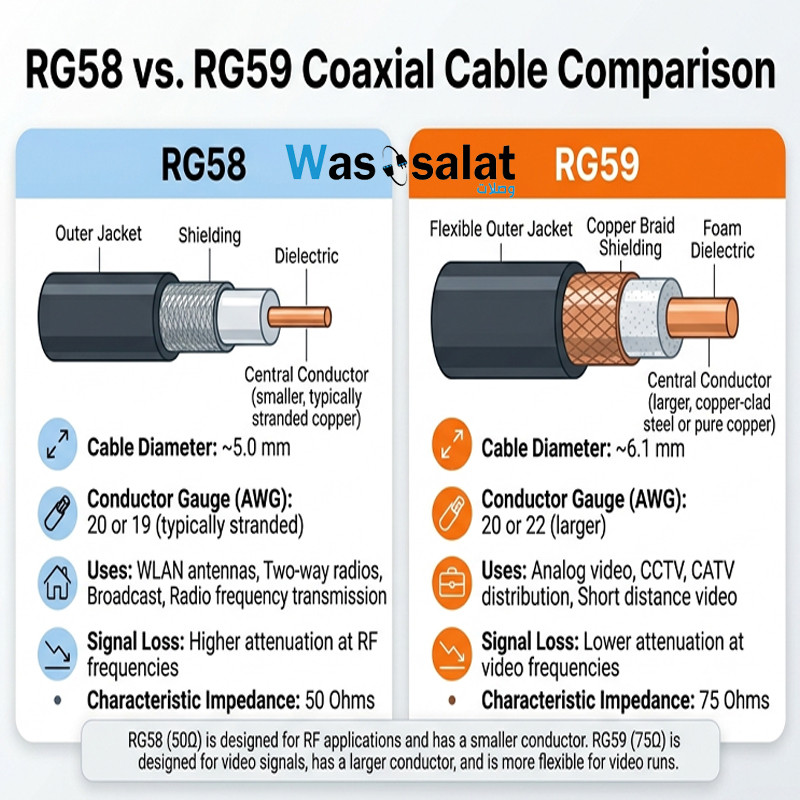 RG58 vs RG59 Coaxial Cables: What's the Difference?
Compare RG58 and RG59 coaxial cables. Learn the critical impedance difference, applications for RF vs video, and...Read more
RG58 vs RG59 Coaxial Cables: What's the Difference?
Compare RG58 and RG59 coaxial cables. Learn the critical impedance difference, applications for RF vs video, and...Read more -
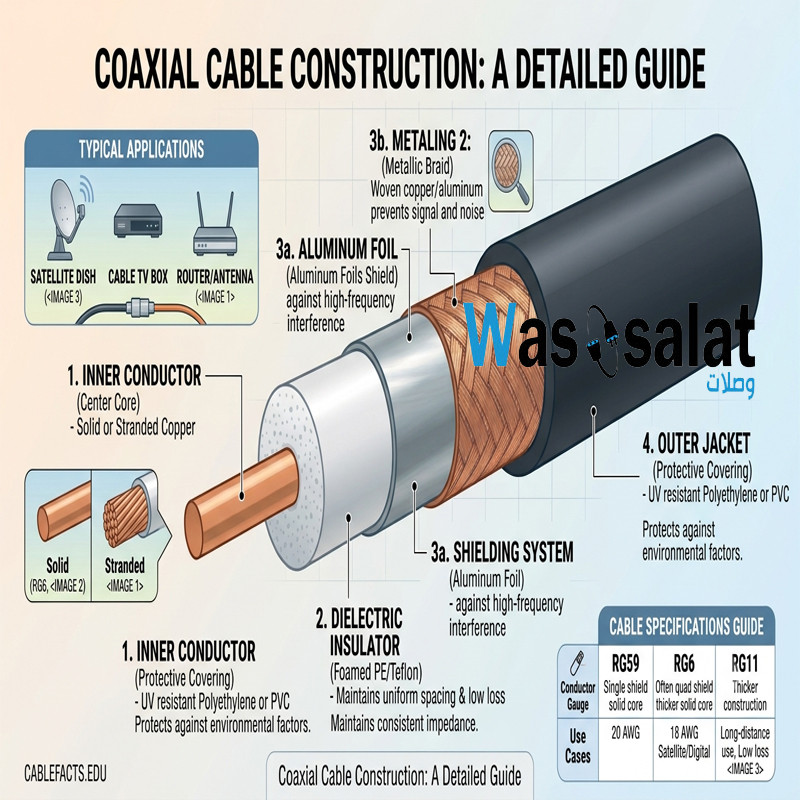 Coaxial Cable Construction: A Complete Layer-by-Layer Breakdown
Learn how coaxial cables are constructed. Understand each layer—conductor, dielectric, shield, and jacket—and how...Read more
Coaxial Cable Construction: A Complete Layer-by-Layer Breakdown
Learn how coaxial cables are constructed. Understand each layer—conductor, dielectric, shield, and jacket—and how...Read more
Latest posts
-
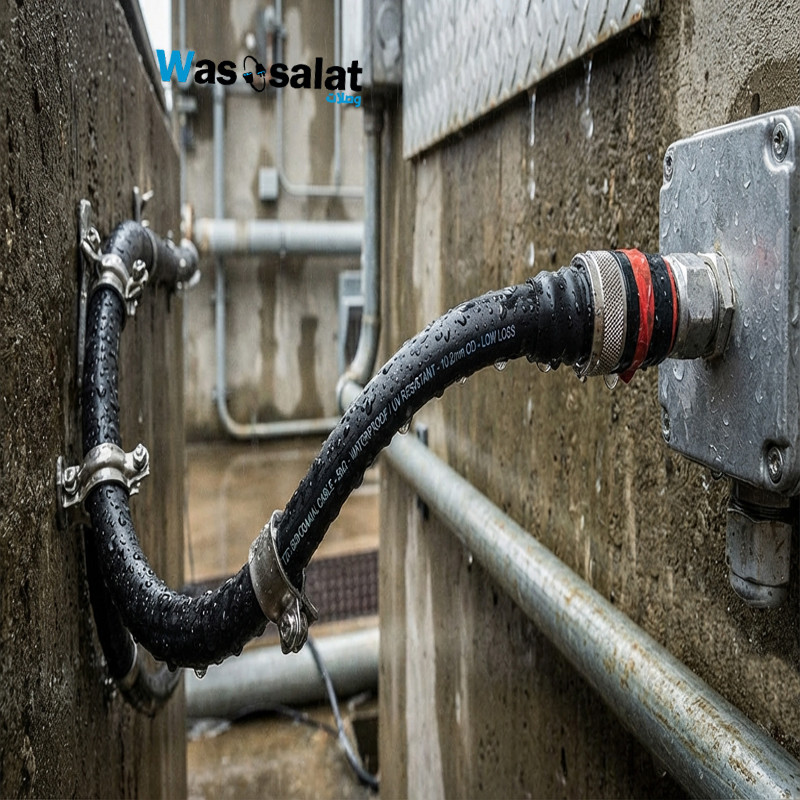 Waterproof Coaxial Cable: The Complete GuideRead more
 -
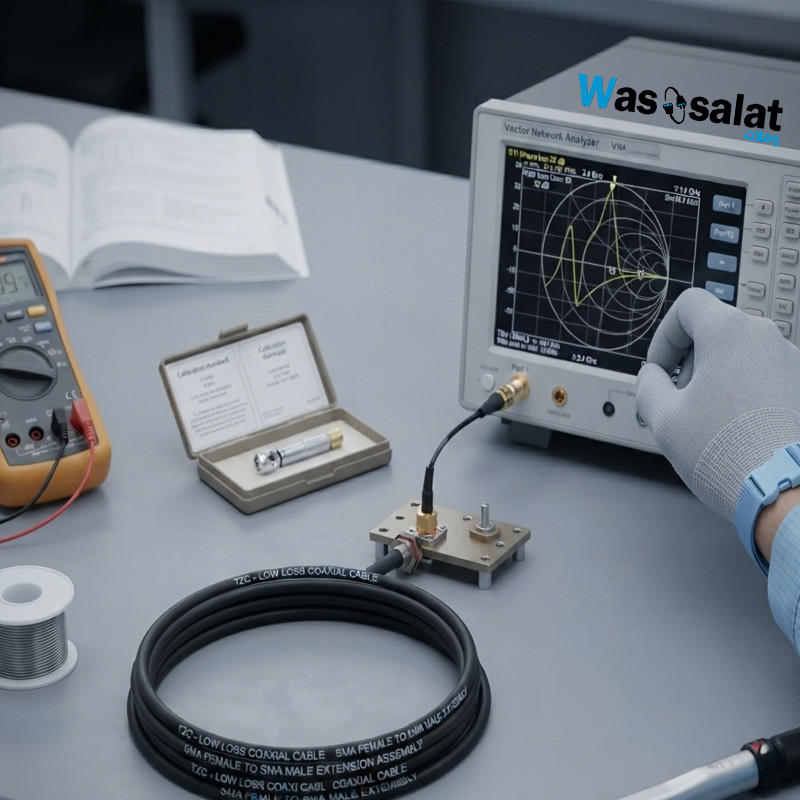 Testing Coaxial Cable: The Complete GuideRead more
This comprehensive guide covers everything you need to know about testing coaxial cable—from simple continuity checks...
-
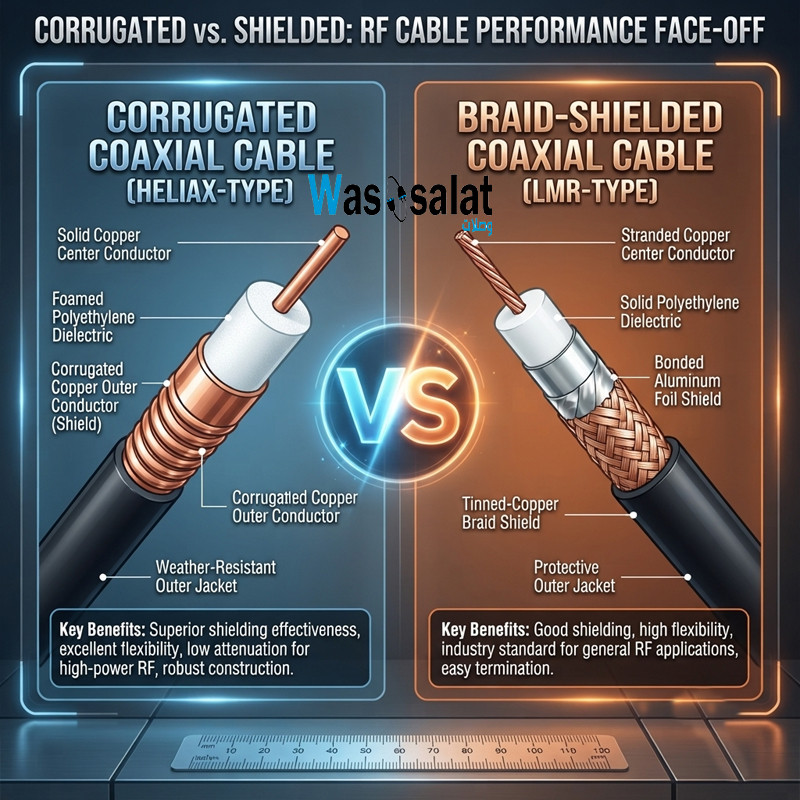 Corrugated Coaxial Cable vs Shielded Coaxial Cable: Complete ComparisonRead more
This comprehensive guide compares both technologies—explaining the differences in construction, performance,...
-
 Installing Coaxial Cable: The Complete GuideRead more
This comprehensive guide compares double shield and quad shield coaxial cables—explaining the differences in...
-
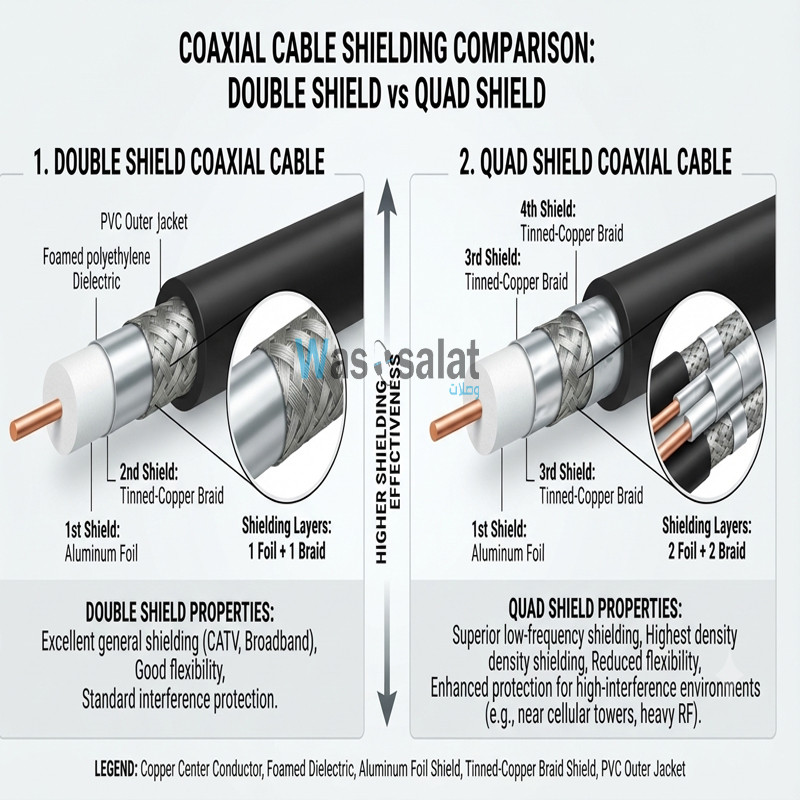 Double Shield vs Quad Shield: Which Coaxial Cable Should You Choose?Read more
This comprehensive guide compares double shield and quad shield coaxial cables—explaining the differences in...
-
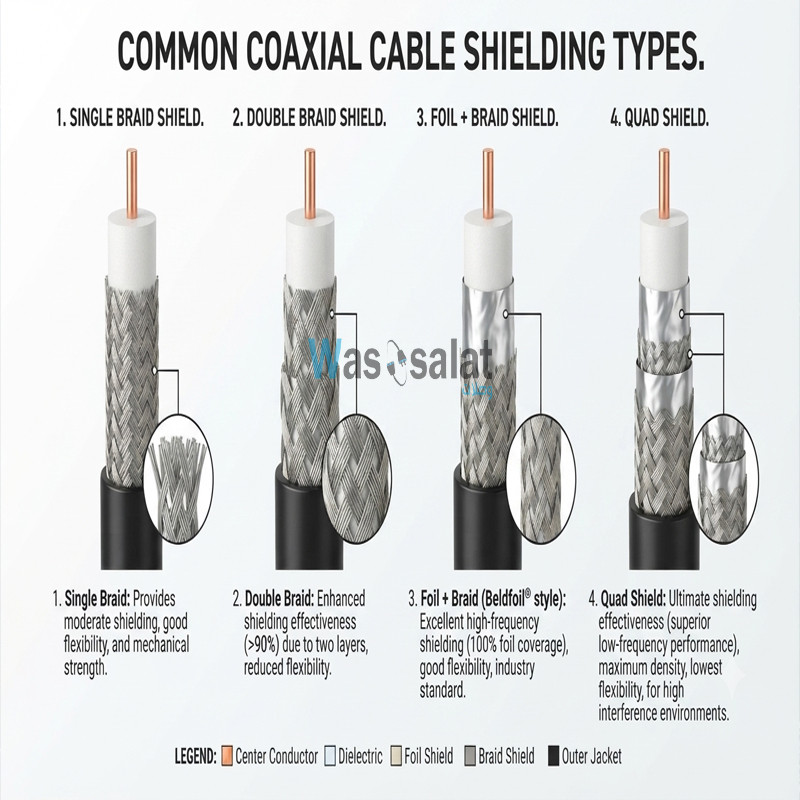 Shielding Types in Coaxial Cables: Complete GuideRead more
This comprehensive guide explains everything you need to know about shielding types—from single shield to quad...
-
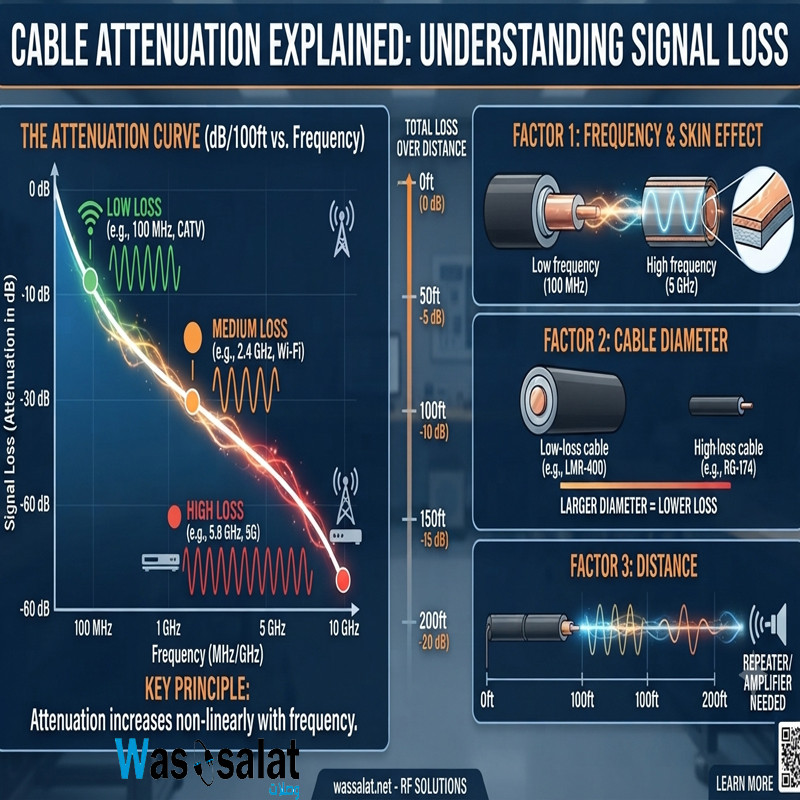 Cable Attenuation Explained: Understanding Signal LossRead more
This comprehensive guide explains everything you need to know about cable attenuation—what it is, what causes it, how...
-
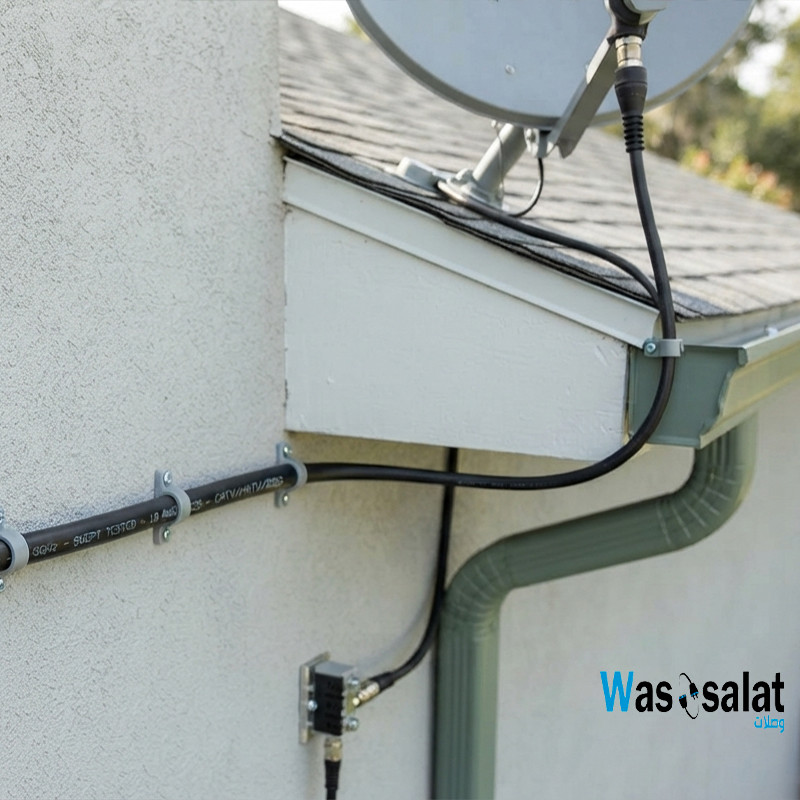 Outdoor Coaxial Cable: Complete Guide & Selection TipsRead more
Choose the right outdoor coaxial cable for your installation. Compare TZC-500/32 vs TZC-500/97, learn about PE...
-
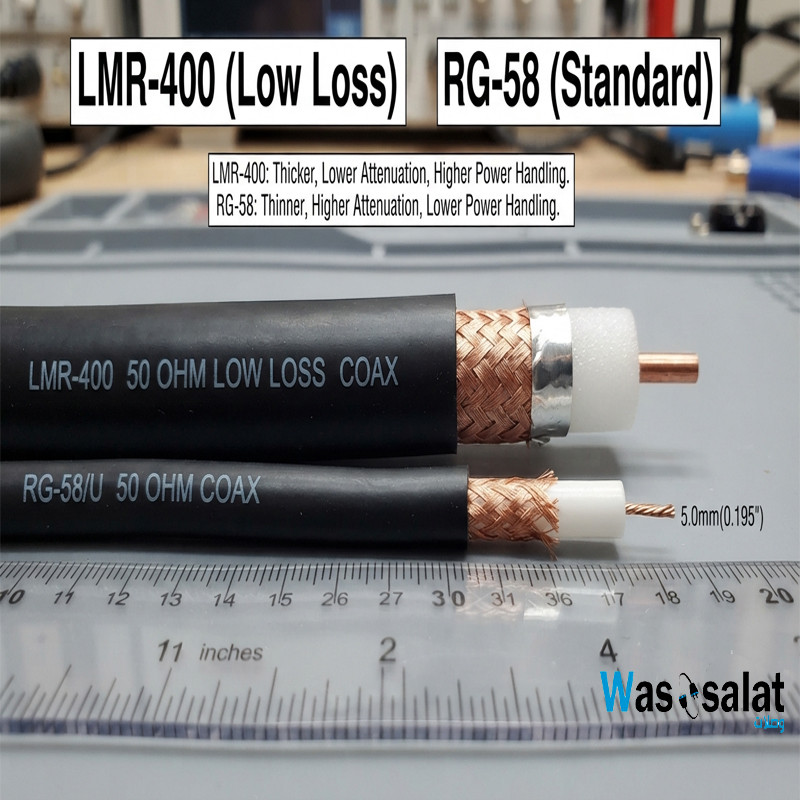 LMR-400 vs RG58: Which Coaxial Cable Should You Choose?Read more
Compare LMR-400 vs RG58 coaxial cables. Learn the differences in signal loss, construction, flexibility, and...
-
 Coax Cable Connectors: Complete Guide to F-Type, BNC, N-Type, SMARead more
Learn about coaxial cable connectors—F-Type, BNC, N-Type, SMA, TNC, and UHF. Compare impedances, frequencies, and...
Leave a comment