

This comprehensive guide covers everything you need to know about waterproof coaxial cables—from understanding water...
Coaxial Cable Construction: A Complete Layer-by-Layer Breakdown
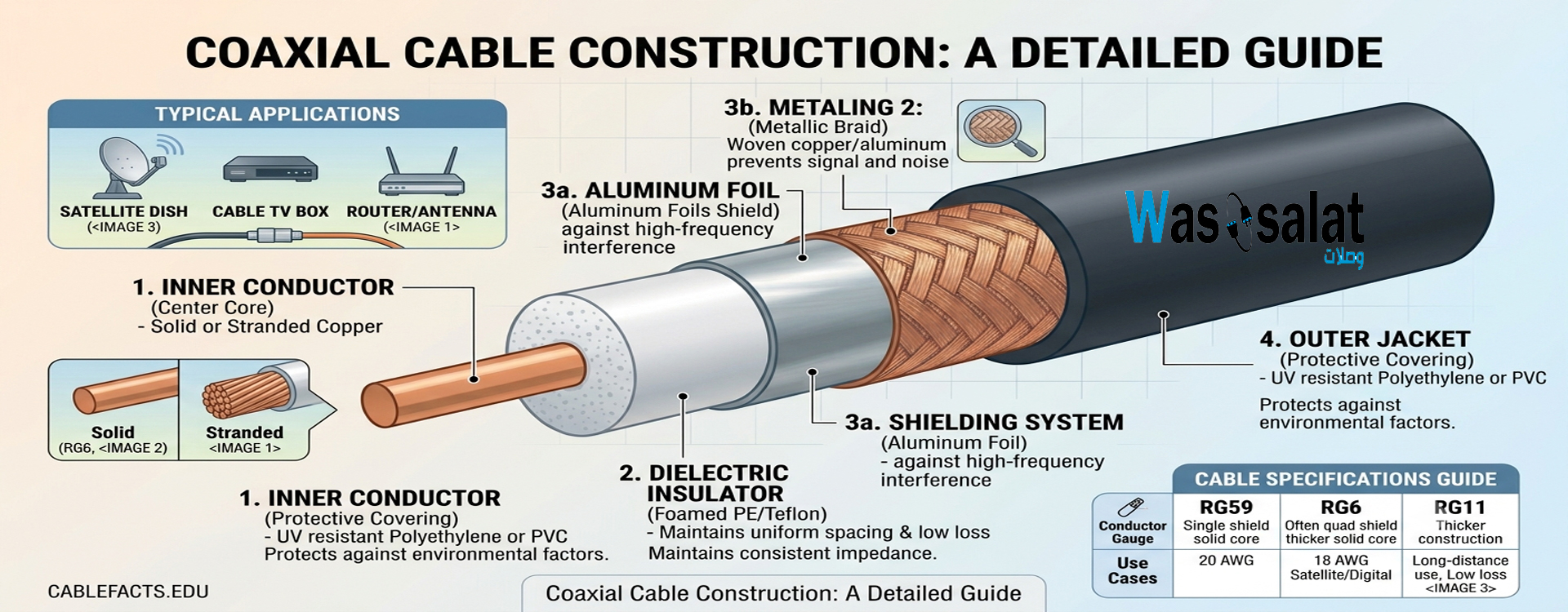
Coaxial Cable Construction: A Complete Breakdown
Published by Wassalat Technical Team
Have you ever wondered what's inside a coaxial cable? Behind the simple black jacket lies a sophisticated engineering design that makes high-frequency signal transmission possible.
This comprehensive guide takes you layer by layer through the construction of coaxial cables—explaining what each component does, what materials are used, and why every layer matters for performance.
? Table of Contents
Overview: The Four Layers
Every coaxial cable consists of four main layers working together to transmit signals with minimal loss and interference:
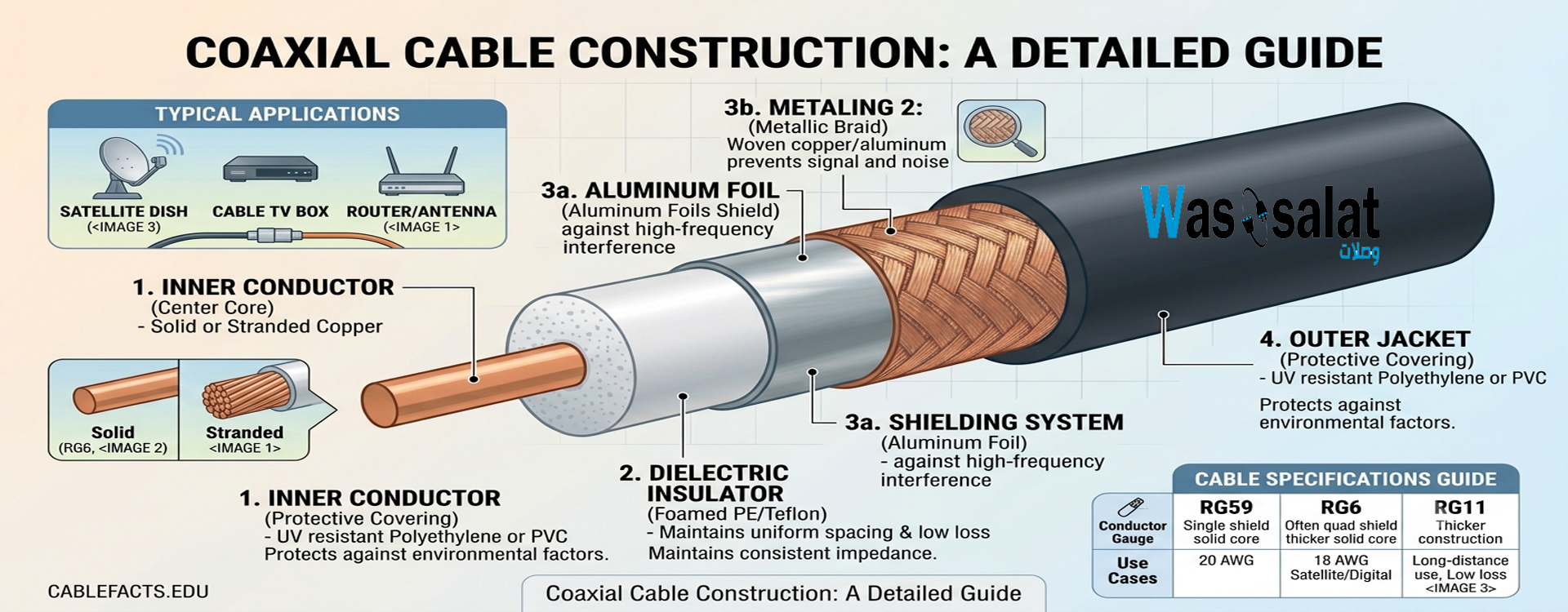
| Layer | Primary Function | Key Material |
|---|---|---|
| 1. Center Conductor | Carries the electrical signal | Copper, CCS, or CCA |
| 2. Dielectric Insulation | Separates conductor from shield | PE, Foam PE, PTFE |
| 3. Metallic Shield | Blocks interference | Copper Braid, Foil |
| 4. Outer Jacket | Protects from damage | PVC, PE, Plenum |
? Key Insight: The performance of a coaxial cable depends on the quality of each layer AND how well they work together. A weak link in any layer compromises the entire cable.
Center Conductor
The center conductor is the heart of the coaxial cable. It carries the electrical signal from the source to the destination.
Conductor Materials
| Material | Conductivity | Cost | Common Use |
|---|---|---|---|
| Solid Copper | Excellent (100%) | High | Premium cables |
| Copper-Clad Steel (CCS) | Good (≈61%) | Medium | RG-6, RG-59 |
| Copper-Clad Aluminum (CCA) | Fair (≈63%) | Low | Budget cables |
| Stranded Copper | Excellent (≈98%) | Very High | Flexible patch cables |
Solid vs Stranded Conductors
| Feature | Solid Conductor | Stranded Conductor |
|---|---|---|
| Flexibility | Poor | Excellent |
| Signal Loss | Lower | Slightly Higher |
| Cost | Lower | Higher |
| Best For | Permanent installations | Patch cables, mobile use |
Conductor Size (AWG)
The conductor size is measured in AWG (American Wire Gauge). Lower numbers = thicker wire.
- RG-6 – 18 AWG (1.02 mm diameter)
- RG-59 – 22 AWG (0.64 mm diameter)
- RG-11 – 14 AWG (1.63 mm diameter)
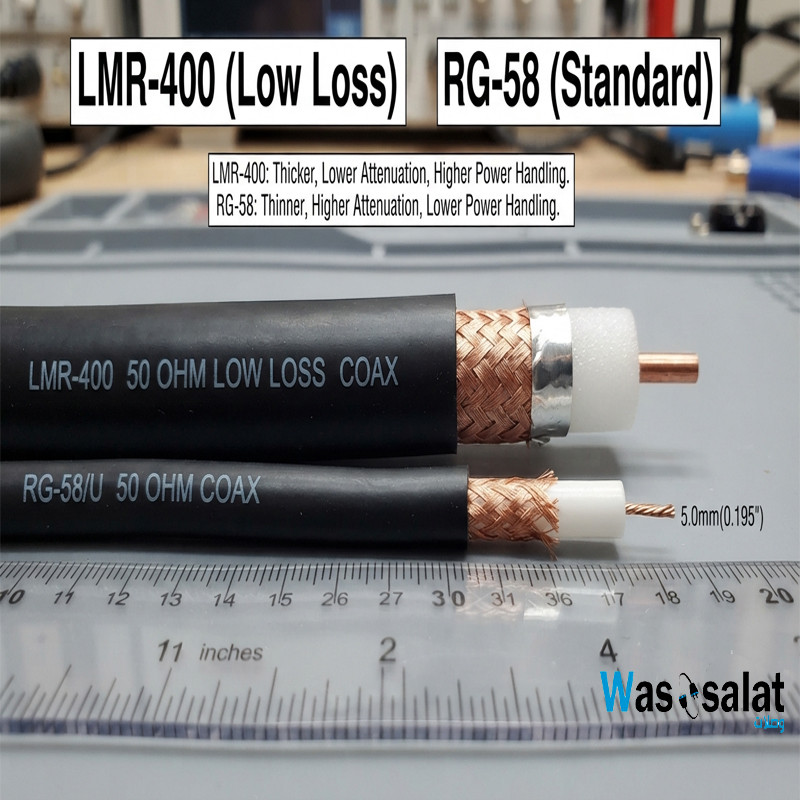
- RG-58 – 20 AWG (0.81 mm diameter)
- LMR-400 – 13 AWG (1.80 mm diameter)
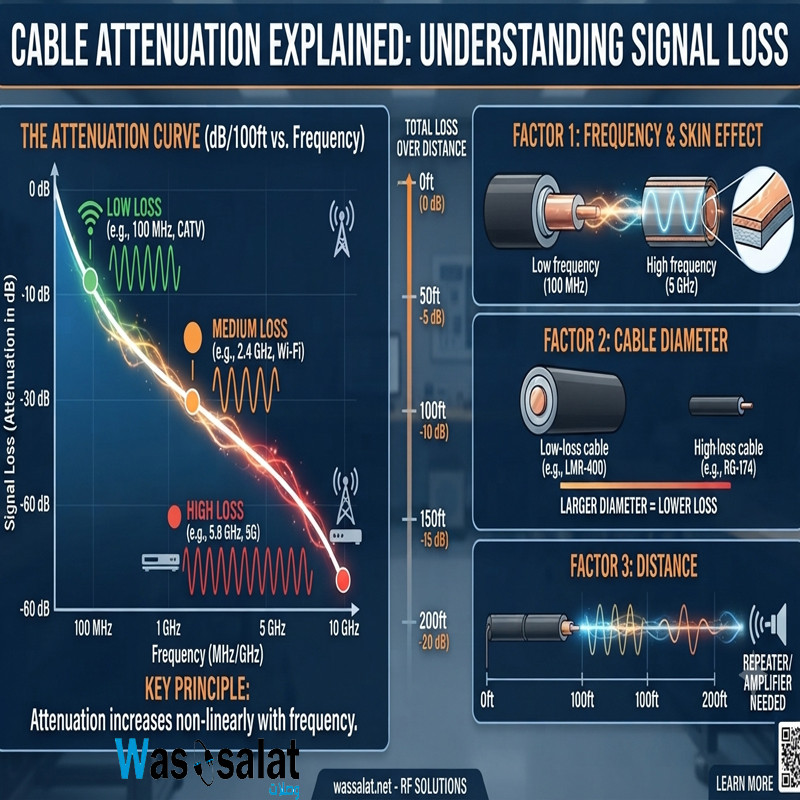
⚠️ Note: A thicker conductor means less resistance, which means less signal loss. This is why RG-11 (14 AWG) has lower loss than RG-6 (18 AWG).
Dielectric Insulation
The dielectric (or insulator) separates the center conductor from the shield. It's one of the most important layers for signal quality.
Dielectric Materials
| Material | Dielectric Constant | Signal Speed | Common Use |
|---|---|---|---|
| Solid Polyethylene (PE) | 2.26 | ~66% of light | RG-58, RG-59 |
| Foam Polyethylene | 1.4-1.6 | ~83% of light | RG-6, RG-11 |
| PTFE (Teflon) | 2.1 | ~69% of light | High-temperature cables |
| Air-Spaced | ≈1.0 | ~96% of light | Specialty low-loss cables |
Why Foam Dielectric is Better
Foam dielectric is used in RG-6 and RG-11 because:
- Lower signal loss – More air means less signal absorption
- Faster signal speed – Higher velocity of propagation
- Lighter weight – Foam is lighter than solid plastic
- Better bending – Foam is more flexible
✅ Pro Tip: Look for "foam PE" or "foam dielectric" when buying RG-6. It offers significantly better performance than solid dielectric.
Metallic Shield
The metallic shield is what makes coaxial cables special. It blocks interference from entering the cable and prevents signal leakage.
Shield Types
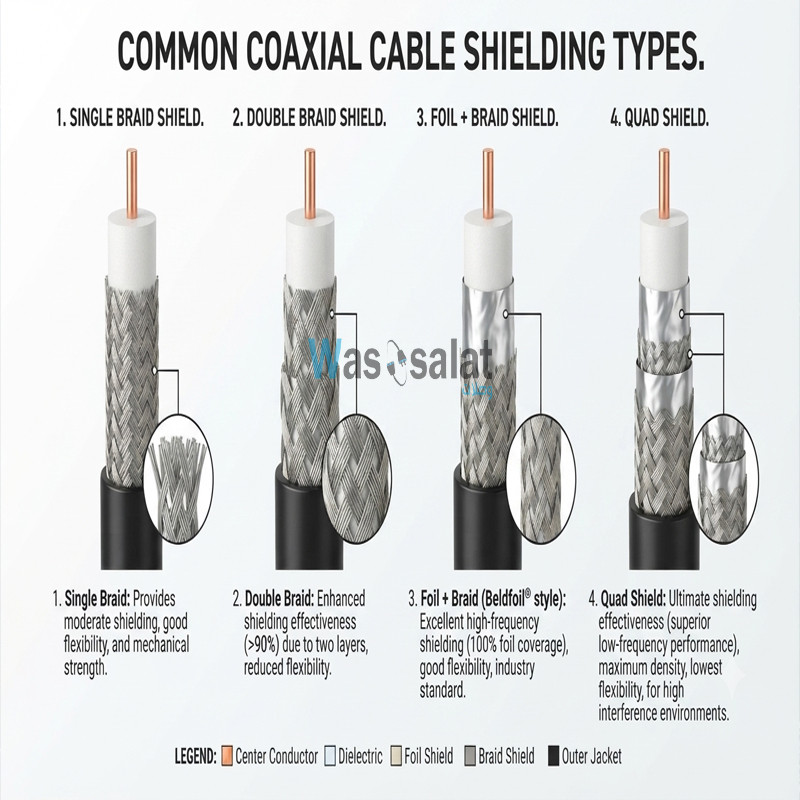
1. Braided Shield
Construction: Woven copper or aluminum wires
Coverage: 60% to 95%
Advantages: Flexible, excellent for mobile applications
Disadvantages: Can have gaps (interference can leak through)
2. Foil Shield
Construction: Thin aluminum foil wrapped around the dielectric
Coverage: 100%
Advantages: Complete coverage, excellent high-frequency protection
Disadvantages: Less flexible, can tear
3. Combination Shield
Construction: Foil + Braid
Coverage: ≈100%
Advantages: Best of both worlds, excellent protection
Disadvantages: More expensive, thicker
4. Solid Copper Tube
Construction: Solid copper outer conductor
Coverage: 100%
Advantages: Ultimate shielding, lowest loss
Disadvantages: Rigid, expensive
Shield Coverage Comparison
| Shield Type | Coverage | Flexibility | Cost | Common Use |
|---|---|---|---|---|
| Single Braid | 60-80% | Excellent | Low | RG-58, RG-59 |
| Dual Braid | 90-95% | Good | Medium | Premium RG-6 |
| Foil + Braid | ≈100% | Good | Medium | Quad-shield RG-6 |
| Foil + 2 Braids | ≈100% | Fair | High | Satellite RG-6 |
| Solid Copper Tube | 100% | Poor | Very High | LMR-600, Hardline |
Outer Jacket
The outer jacket protects the cable from physical damage, moisture, UV rays, and chemicals.
Jacket Materials
| Material | Temperature Range | Key Feature | Common Use |
|---|---|---|---|
| PVC | -20°C to +80°C | Low cost, flexible | Indoor cables |
| Polyethylene (PE) | -40°C to +80°C | UV resistant, waterproof | Outdoor cables |
| Plenum (FEP/FRPVC) | 0°C to +75°C | Fire retardant, low smoke | Air ducts, plenum spaces |
| TPU (Polyurethane) | -40°C to +85°C | Abrasion resistant | Industrial, robotic |
| TPE (Rubber) | -40°C to +90°C | Flexible, tough | Mobile applications |
Jacket Color Codes
While not standardized, common jacket colors indicate specific applications:
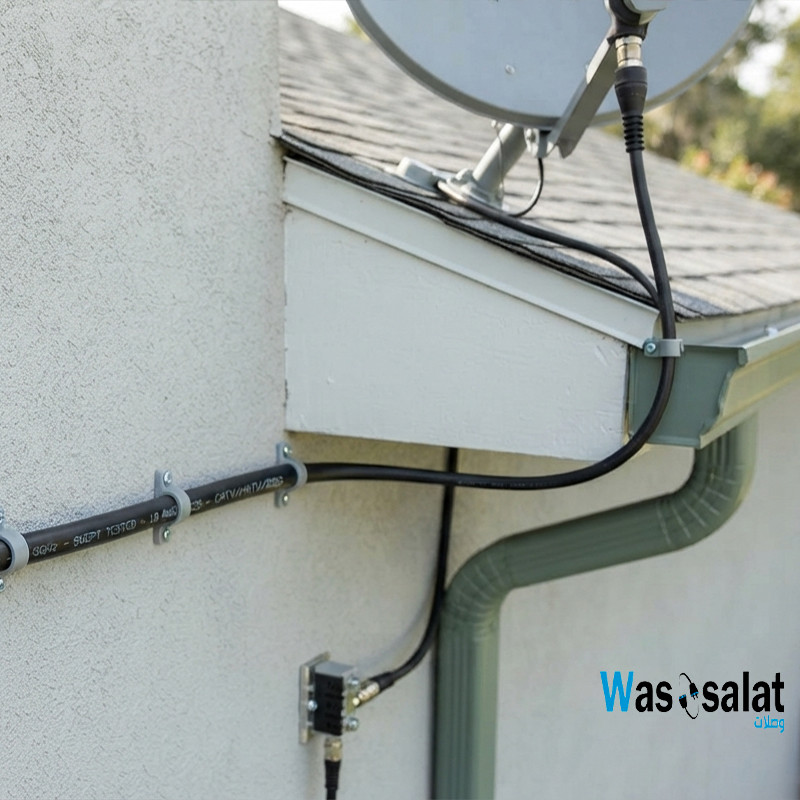
- Black – Outdoor, UV-resistant
- White – Indoor residential
- Blue – CCTV, security
- Orange – High visibility, power
- Yellow – Plenum-rated
- Green – Audio/video
- Red – Critical/fire alarm
Shielding Types Explained
1. Single Shield (Foil or Braid)
Construction: One layer of foil OR one layer of braid
Performance: Basic protection, adequate for most residential use
Common Use: RG-6 (basic), RG-59
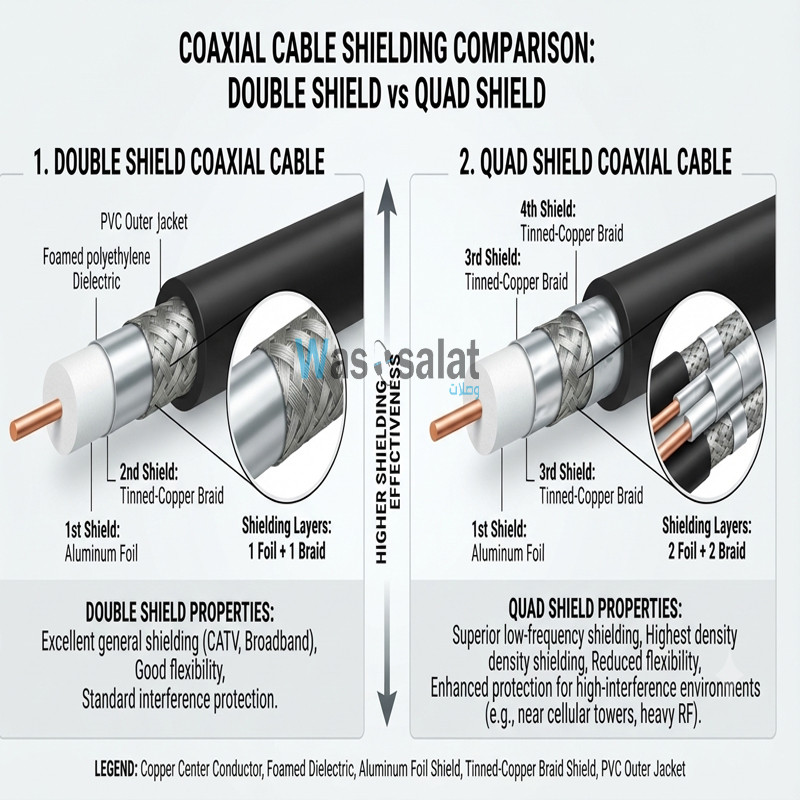
2. Dual Shield (Foil + Braid)
Construction: Foil wrapped around dielectric, braid over foil
Performance: Good protection, suitable for most installations
Common Use: RG-6 (standard)
3. Triple Shield (Foil + Braid + Foil)
Construction: Foil + Braid + Foil
Performance: Very good protection, reduced interference
Common Use: RG-6 (premium)
4. Quad Shield (Foil + Braid + Foil + Braid)
Construction: Foil + Braid + Foil + Braid
Performance: Maximum protection, minimal interference
Common Use: RG-6 (satellite, high-interference areas)
5. Double-Braid Shield
Construction: Two layers of braid (no foil)
Performance: Excellent protection, flexible
Common Use: LMR-400, LMR-600, RG-8
? Recommendation: For satellite TV, use quad-shield RG-6. For standard cable TV, dual-shield is usually sufficient. For RF/wireless, double-braid LMR cables are the professional choice.
Material Comparison
Different materials offer different performance characteristics. Here's how they compare:
| Component | Best Option | Budget Option | Why It Matters |
|---|---|---|---|
| Conductor | Solid Copper | Copper-Clad Steel | Copper has lower resistance |
| Dielectric | Foam PE | Solid PE | Foam has lower loss |
| Shield | Quad Shield | Single Braid | More shield = less interference |
| Jacket | PE (outdoor) | PVC (indoor) | PE resists UV and moisture |
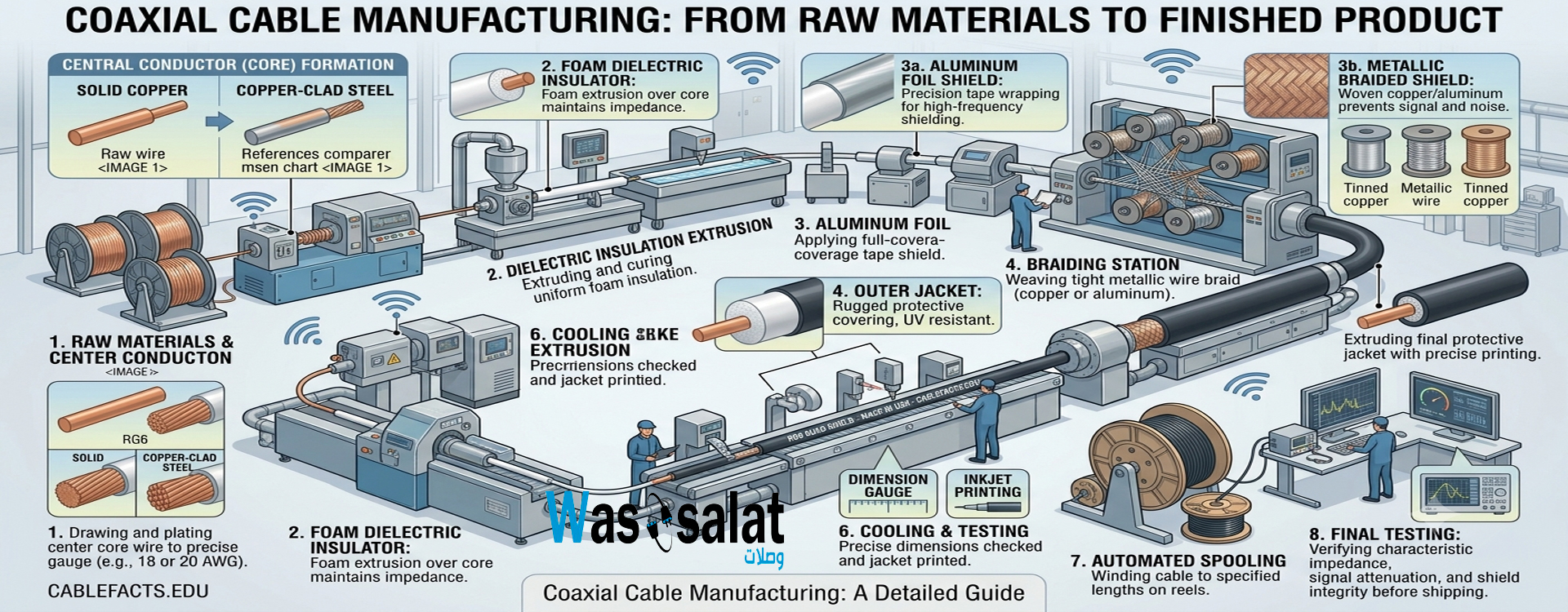
Manufacturing Process
Coaxial cables are manufactured through a precise, multi-step process:
- Wire Drawing – Copper wire is drawn to the correct thickness
- Conductor Manufacturing – Solid or stranded conductor is produced
- Dielectric Extrusion – Plastic is extruded over the conductor
- Foil Application – Aluminum foil is wrapped around the dielectric
- Braid Braiding – Wire braid is woven around the foil
- Jacket Extrusion – Outer jacket is extruded over the shield
- Testing – Cable is tested for impedance, continuity, and loss
- Spooling – Cable is wound onto spools for shipping
Quality Indicators
How can you tell if a coaxial cable is high quality?
What to Look For
| Indicator | Quality Sign | Warning Sign |
|---|---|---|
| Conductor | Solid copper or high-quality CCS | CCA (copper-clad aluminum) |
| Dielectric | Foam PE (white/cream color) | Solid PE, discolored |
| Shield | Tight braid, high coverage | Loose braid, gaps |
| Jacket | Flexible, no cracks | Brittle, stiff, discolored |
| Printing | Clear, legible, specifications | Faded, missing, illegible |
Red Flags to Avoid
- CCA conductor – Inferior performance, higher loss
- Loose braid – Poor shielding, interference susceptibility
- No branding – Unidentified cable, unknown quality
- Brittle jacket – Poor quality material, crack risk
- Missing specifications – Manufacturer hiding poor performance
✅ Golden Rule: You get what you pay for. A $10 spool of coaxial cable is not the same as a $100 spool. Invest in quality for reliable performance.
Frequently Asked Questions (FAQ)
1. What is the most important layer in a coaxial cable?
All layers are important, but the dielectric and shield have the biggest impact on signal quality. The dielectric determines loss, and the shield determines interference rejection.
2. What is the difference between solid and stranded conductor?
Solid conductor is a single wire (better for permanent installations, lower loss). Stranded conductor is multiple wires twisted together (more flexible, good for patch cables).
3. Why is foam dielectric better than solid?
Foam dielectric contains air bubbles that reduce signal loss. Signals travel faster and lose less power through foam than solid plastic.
4. What does "quad-shield" mean?
Quad-shield means the cable has four layers of shielding: two layers of foil and two layers of braid. This provides maximum protection against interference.
5. Can I use outdoor coaxial cable indoors?
Yes. Outdoor cable (PE jacket) can be used indoors. However, indoor cable (PVC jacket) should NOT be used outdoors because it lacks UV and moisture resistance.
6. What is plenum-rated cable?
Plenum-rated cable has a fire-retardant jacket that produces less smoke when burned. It's required by building codes for installation in air circulation spaces.
7. What is the best conductor material?
Solid bare copper is the best conductor material, offering the lowest resistance and best performance. However, it's also the most expensive.
8. Does cable color affect performance?
No. Color is purely for identification and aesthetics. It doesn't affect electrical performance.
9. How can I tell if my cable has a copper or CCA conductor?
Scratch the conductor with a knife. If you see silver (steel) or white (aluminum) underneath, it's CCA or CCS. Solid copper is copper all the way through.
10. What is the minimum bend radius for coaxial cable?
Most coax has a minimum bend radius of 6-10 times the cable diameter. For RG-6, this is about 2-3 inches. For RG-11, it's about 4-6 inches.
11. Can coaxial cable be installed underground?
Yes, but you need "direct burial" rated cable with a PE jacket and often a gel filling to prevent moisture ingress.
12. Why is my coaxial cable stiff?
Stiffness is usually due to a solid conductor or thick shield. Some cables are intentionally stiff for permanent installations. Flexible cables use stranded conductors.
? Related Articles
- Complete Guide to Coaxial Cables
- What Is a Coaxial Cable?
- 50 Ohm vs 75 Ohm Coax
- RG6 vs RG11
- RG58 vs RG59
- Coaxial Cable Connectors Guide
- Browse Coaxial Cables →
? Shop Professional Coaxial Cables
We stock high-quality coaxial cables with solid copper conductors, foam dielectric, and premium shielding. Built to professional standards for reliable performance.
Last Updated: July 2026
© 2026 Wassalat. All rights reserved.
Posted in:
Coaxial Cables
Related posts
-
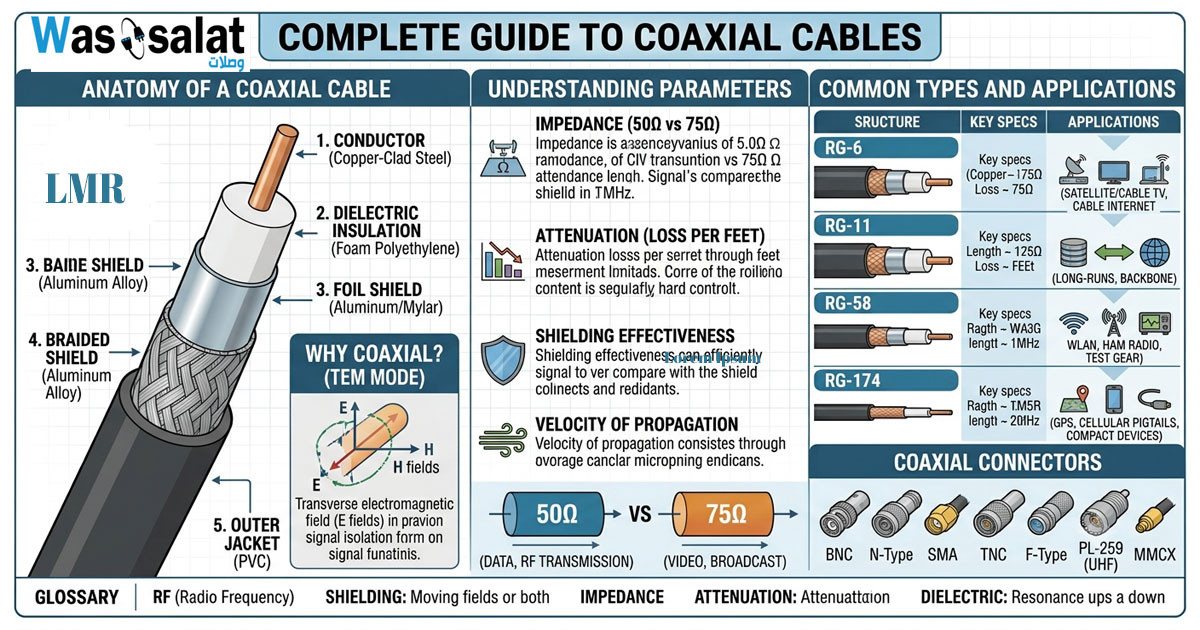 Complete Guide to Coaxial Cables
Everything you need to know about RG-6, LMR-400, impedance, connectors & troubleshooting.Read more
Complete Guide to Coaxial Cables
Everything you need to know about RG-6, LMR-400, impedance, connectors & troubleshooting.Read more -
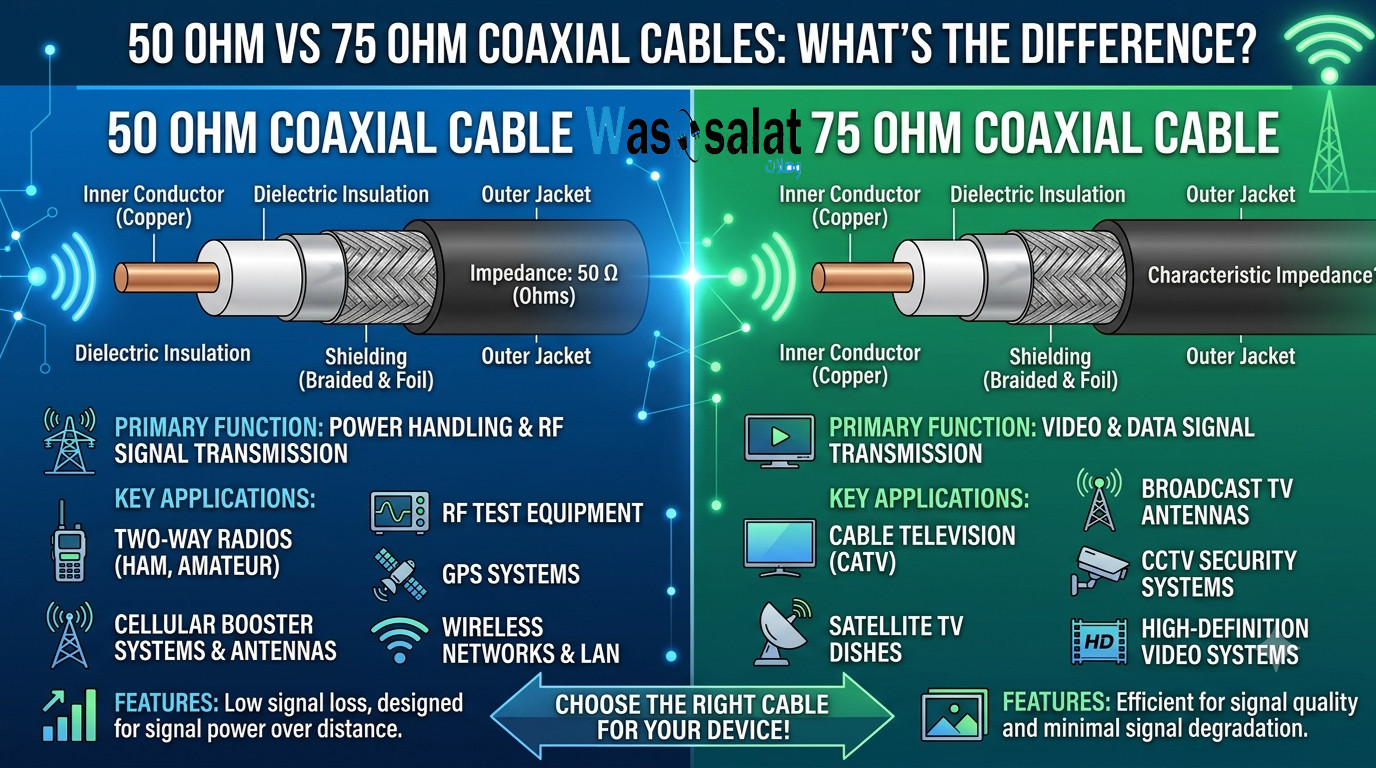 50 Ohm vs 75 Ohm Coaxial Cables: What's the Difference?
Learn the key differences between 50Ω and 75Ω coaxial cables. Find out which impedance you need for WiFi, TV, CCTV,...Read more
50 Ohm vs 75 Ohm Coaxial Cables: What's the Difference?
Learn the key differences between 50Ω and 75Ω coaxial cables. Find out which impedance you need for WiFi, TV, CCTV,...Read more -
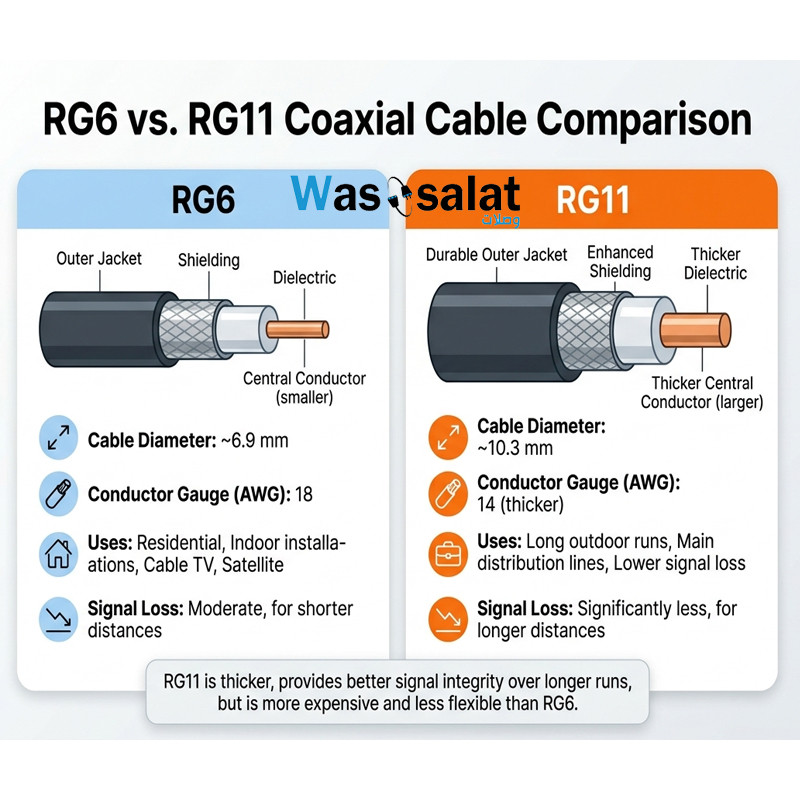 RG6 vs RG11 Coaxial Cables: Which One Do You Need?
Compare RG6 and RG11 coaxial cables. Learn the differences in performance, distance, cost, and when to use each for...Read more
RG6 vs RG11 Coaxial Cables: Which One Do You Need?
Compare RG6 and RG11 coaxial cables. Learn the differences in performance, distance, cost, and when to use each for...Read more -
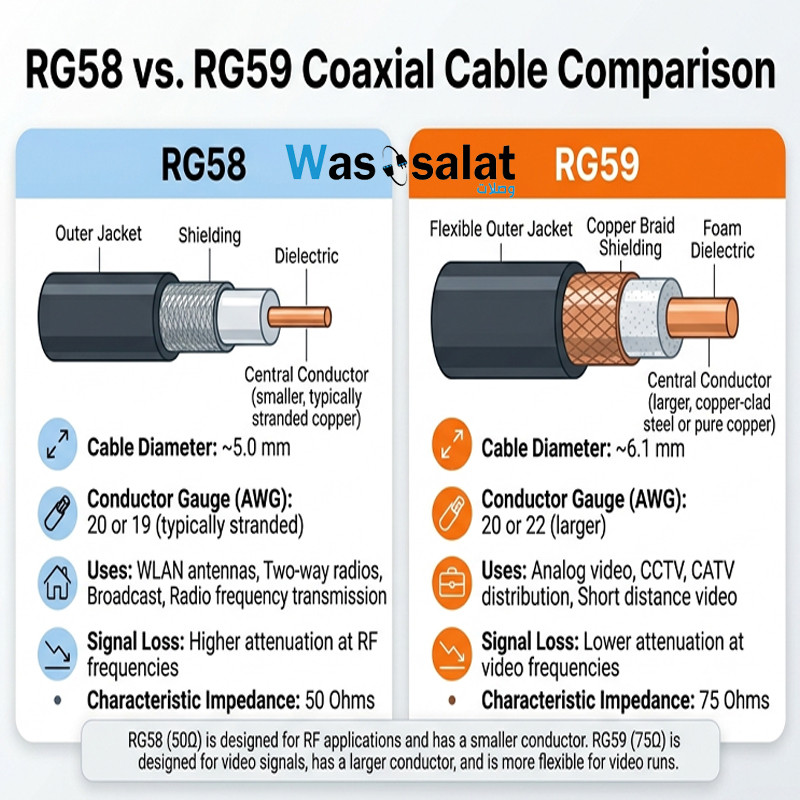 RG58 vs RG59 Coaxial Cables: What's the Difference?
Compare RG58 and RG59 coaxial cables. Learn the critical impedance difference, applications for RF vs video, and...Read more
RG58 vs RG59 Coaxial Cables: What's the Difference?
Compare RG58 and RG59 coaxial cables. Learn the critical impedance difference, applications for RF vs video, and...Read more -
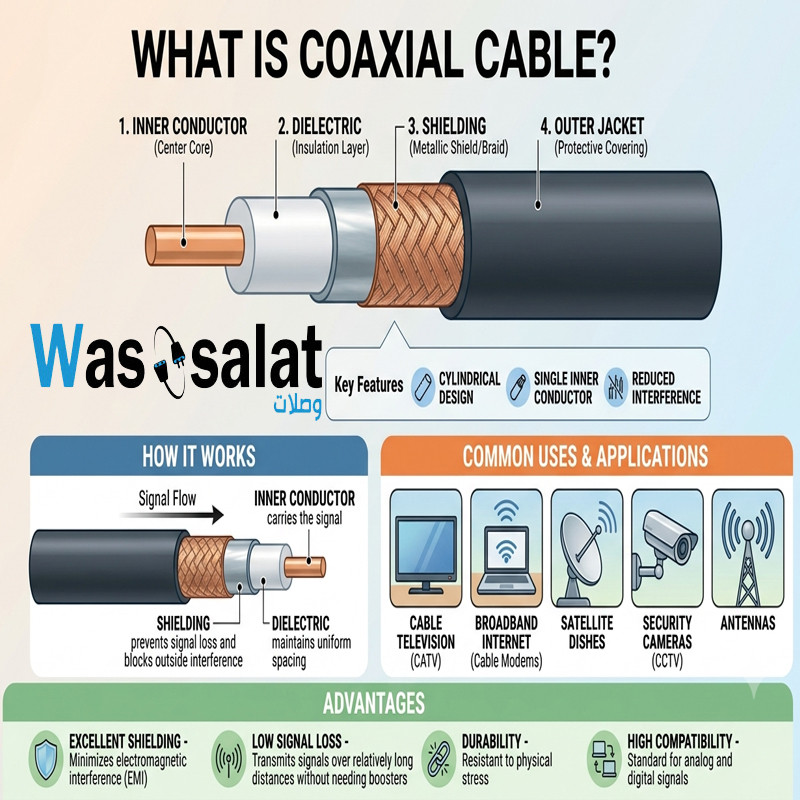 What Is a Coaxial Cable? The Complete Beginner's Guide
Learn what coaxial cables are, how they work, their construction, types, and applications. The beginner's guide to...Read more
What Is a Coaxial Cable? The Complete Beginner's Guide
Learn what coaxial cables are, how they work, their construction, types, and applications. The beginner's guide to...Read more
Latest posts
-
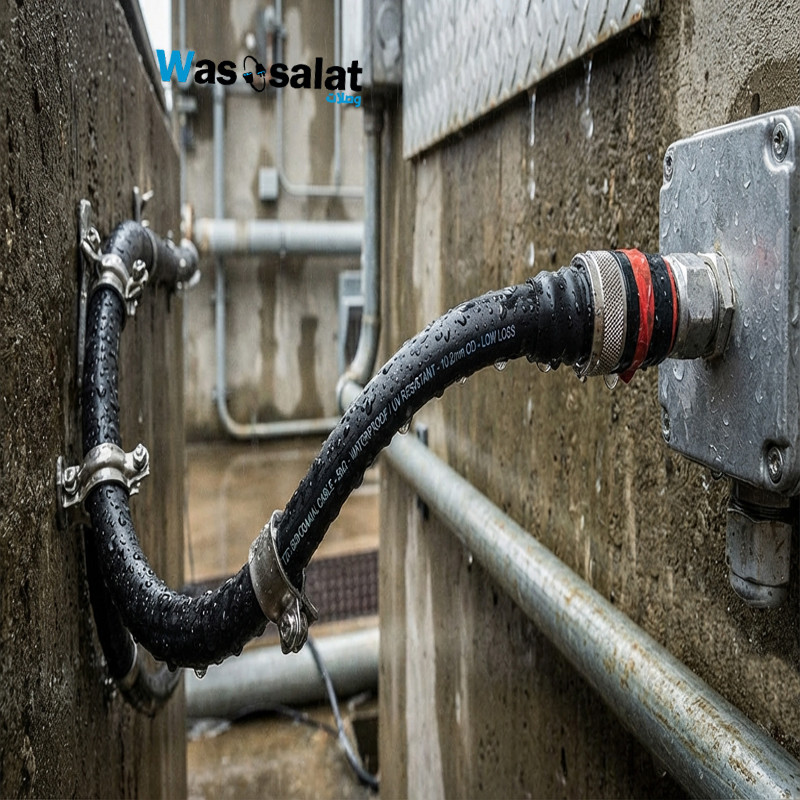 Waterproof Coaxial Cable: The Complete GuideRead more
 -
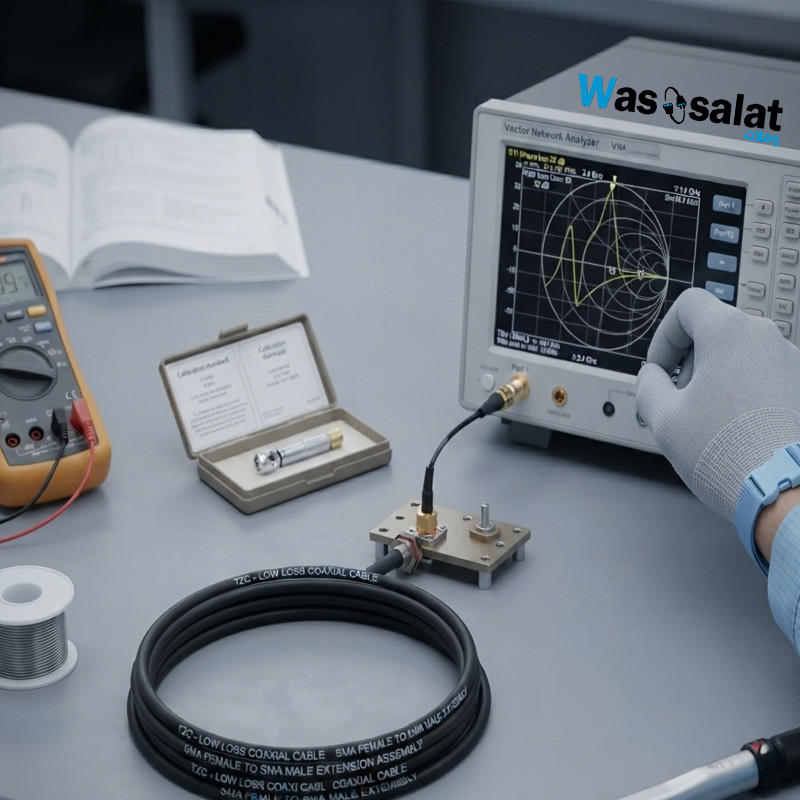 Testing Coaxial Cable: The Complete GuideRead more
This comprehensive guide covers everything you need to know about testing coaxial cable—from simple continuity checks...
-
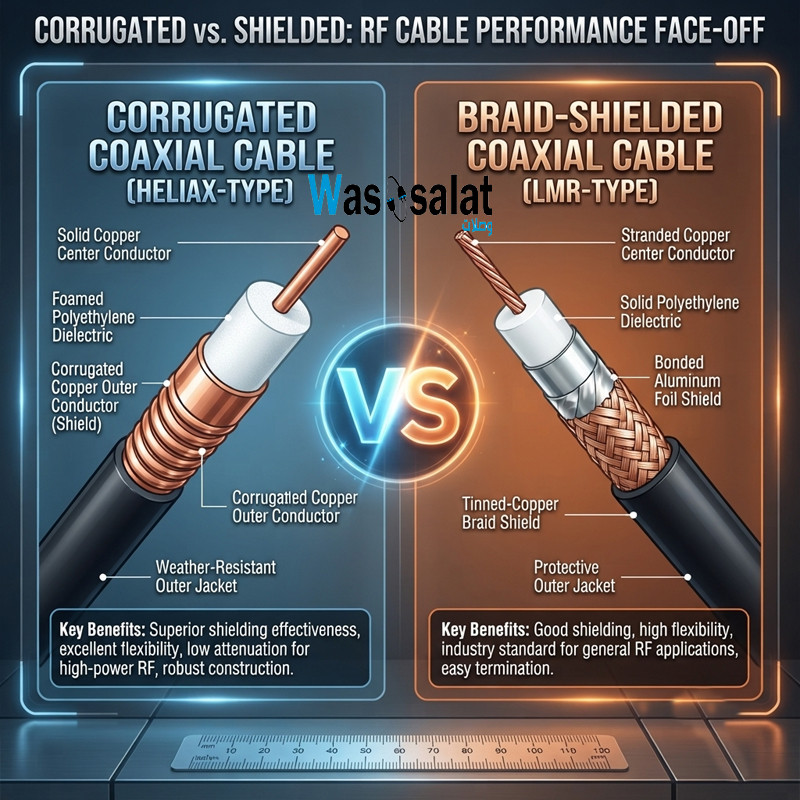 Corrugated Coaxial Cable vs Shielded Coaxial Cable: Complete ComparisonRead more
This comprehensive guide compares both technologies—explaining the differences in construction, performance,...
-
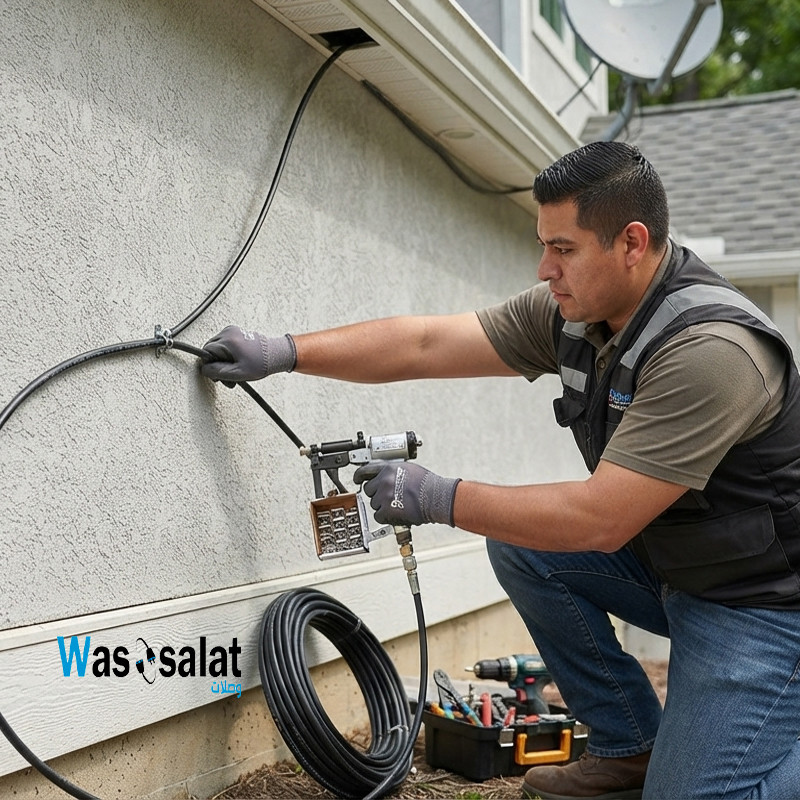 Installing Coaxial Cable: The Complete GuideRead more
This comprehensive guide compares double shield and quad shield coaxial cables—explaining the differences in...
-
 Double Shield vs Quad Shield: Which Coaxial Cable Should You Choose?Read more
This comprehensive guide compares double shield and quad shield coaxial cables—explaining the differences in...
-
 Shielding Types in Coaxial Cables: Complete GuideRead more
This comprehensive guide explains everything you need to know about shielding types—from single shield to quad...
-
 Cable Attenuation Explained: Understanding Signal LossRead more
This comprehensive guide explains everything you need to know about cable attenuation—what it is, what causes it, how...
-
 Outdoor Coaxial Cable: Complete Guide & Selection TipsRead more
Choose the right outdoor coaxial cable for your installation. Compare TZC-500/32 vs TZC-500/97, learn about PE...
-
 LMR-400 vs RG58: Which Coaxial Cable Should You Choose?Read more
Compare LMR-400 vs RG58 coaxial cables. Learn the differences in signal loss, construction, flexibility, and...
-
 Coax Cable Connectors: Complete Guide to F-Type, BNC, N-Type, SMARead more
Learn about coaxial cable connectors—F-Type, BNC, N-Type, SMA, TNC, and UHF. Compare impedances, frequencies, and...
Leave a comment