

This comprehensive guide covers everything you need to know about waterproof coaxial cables—from understanding water...
Corrugated Coaxial Cable vs Shielded Coaxial Cable: Complete Comparison
Corrugated Coaxial Cable vs Shielded Coaxial Cable: Complete Comparison
Published by Wassalat Technical Team
When it comes to professional RF installations, choosing the right cable is critical for signal integrity, reliability, and long-term performance. Two popular options are corrugated coaxial cables (like HELIAX®) and traditional shielded coaxial cables (like RG6, RG11, and LMR series).
This comprehensive guide compares both technologies—explaining the differences in construction, performance, applications, and cost—so you can make the right choice for your installation.
? Table of Contents
Quick Overview
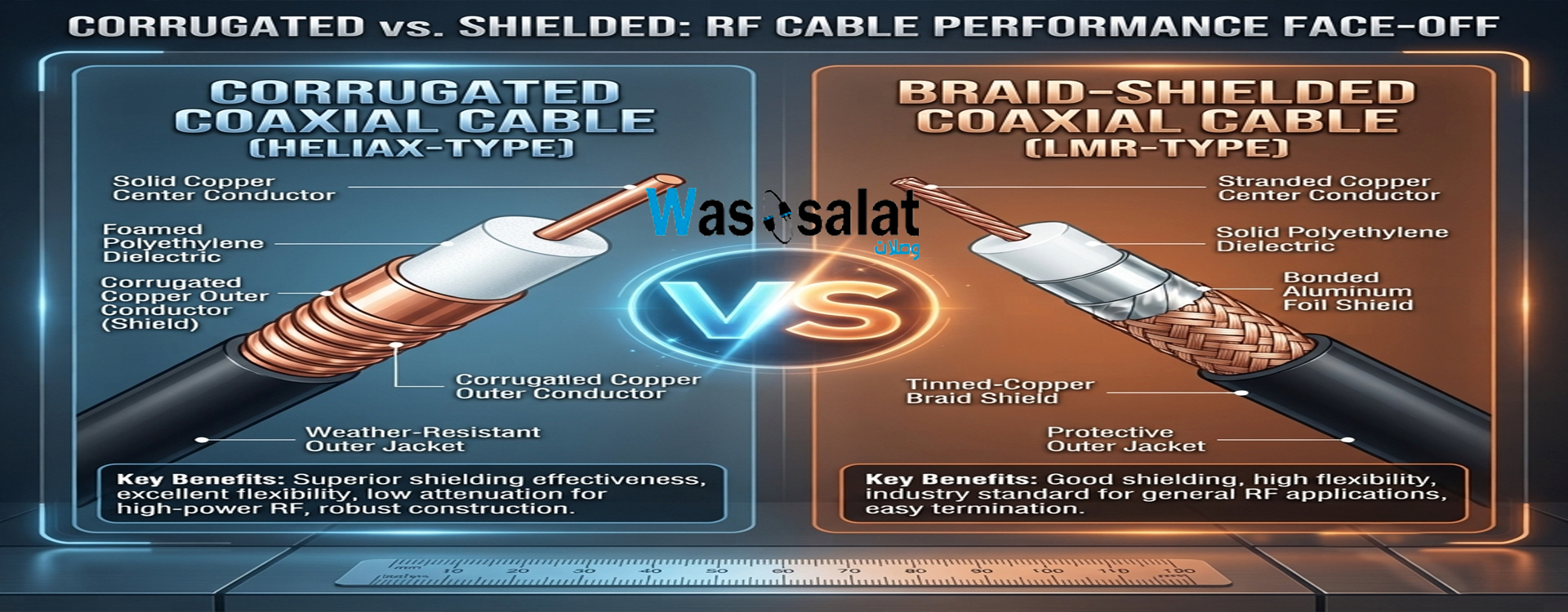
The short answer is: Corrugated coaxial cables (like HELIAX®) are designed for maximum performance in high-power, high-frequency applications with superior shielding and lower loss. Traditional shielded cables (like LMR-400 or RG6) offer a good balance of performance, flexibility, and cost for most RF installations.
? Corrugated Coaxial
- Construction: Corrugated copper or aluminum outer conductor
- Protection: Maximum shielding effectiveness
- Loss: Ultra-low attenuation
- Cost: Higher
- Flexibility: Moderate (corrugated design allows bending)
- Best For: High-power RF, broadcast, cellular base stations, long runs
?️ Shielded Coaxial
- Construction: Foil and/or braid outer conductor
- Protection: Good to excellent shielding
- Loss: Low to moderate (varies by type)
- Cost: Lower
- Flexibility: Excellent to good
- Best For: General RF, WiFi, TV, data, short to medium runs
? Key Insight: The main difference is the outer conductor design. Corrugated cables use a rigid, corrugated metal tube for maximum shielding and lower loss. Shielded cables use flexible foil and braid layers for good shielding with better flexibility.
What Is Corrugated Coaxial Cable?
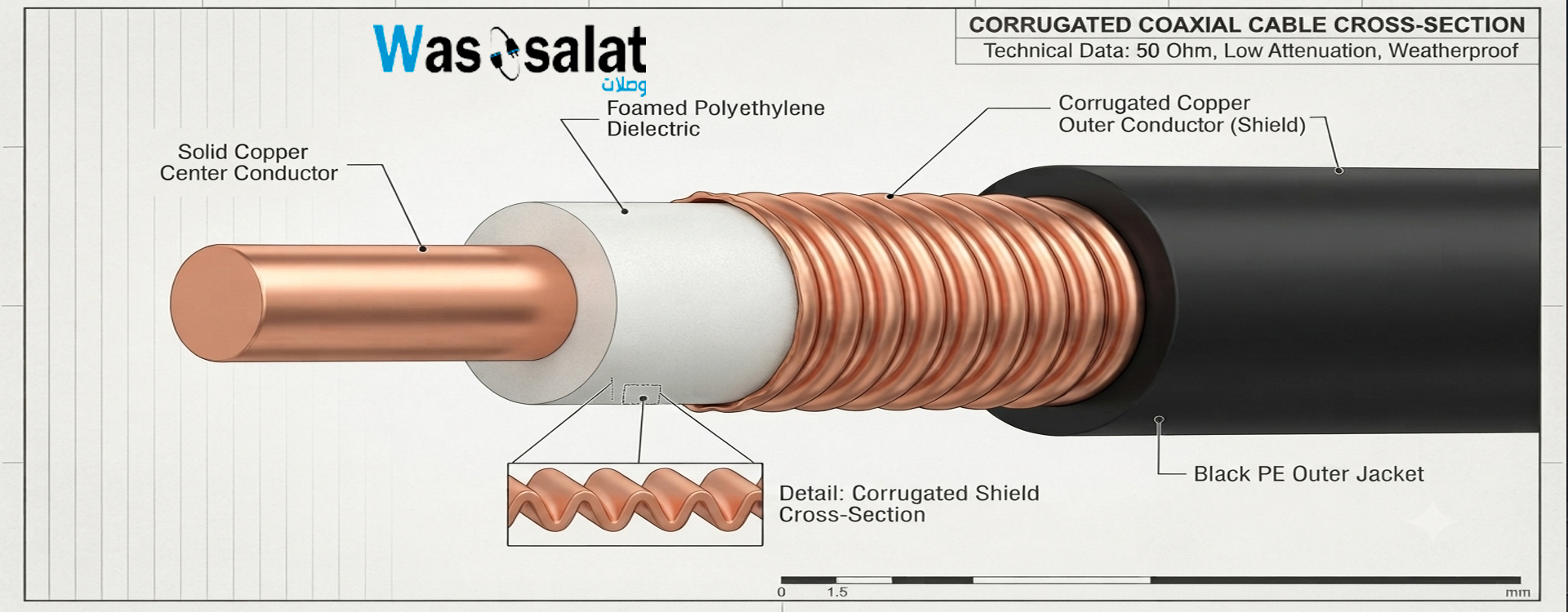
Corrugated coaxial cable (often known by the brand name HELIAX®) is a specialized type of coaxial cable that uses a corrugated metal outer conductor instead of a braided or foil shield. The corrugated design provides exceptional electrical performance and mechanical durability.
Key Characteristics
✅ Advantages
- Ultra-low loss – Superior attenuation performance
- Excellent shielding – 100% coverage, no gaps
- High power handling – Handles high RF power
- Weatherproof – Sealed against moisture ingress
- Durable – Resists crushing and kinking
- Long runs – Low loss allows very long cable runs
❌ Disadvantages
- Higher cost – More expensive per foot
- Stiffer – Less flexible than braided cables
- Special connectors – Requires special clamp connectors
- Heavier – More weight per foot
- Tooling required – Specialized installation tools needed
Common Types
| Type | Outer Conductor | Impedance | Common Use |
|---|---|---|---|
| HELIAX® 1/2" | Corrugated Copper | 50Ω | Cellular, base stations |
| HELIAX® 5/8" | Corrugated Copper | 50Ω | High-power RF |
| HELIAX® 7/8" | Corrugated Copper | 50Ω | Broadcast, high-power |
| HELIAX® 1-1/4" | Corrugated Copper | 50Ω | Very long runs |
What Is Shielded Coaxial Cable?
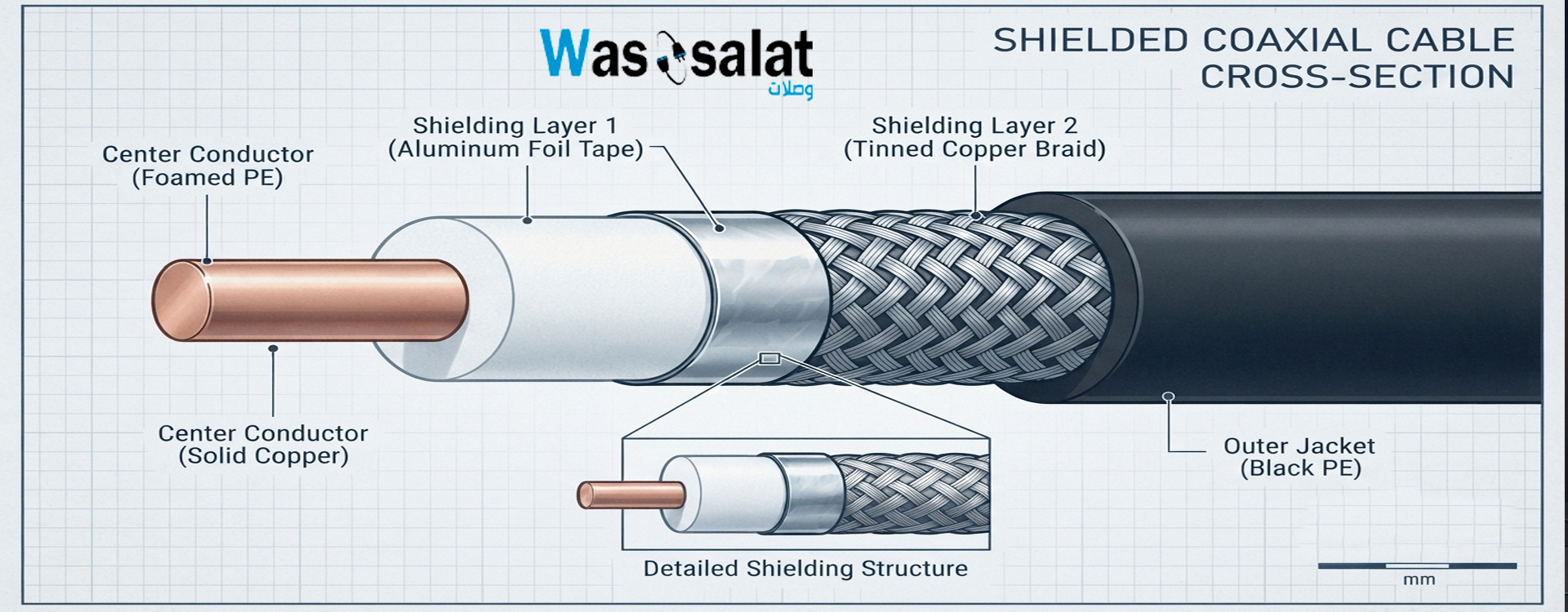
Shielded coaxial cable is the most common type of coaxial cable. It uses one or more layers of foil and/or braided metal as the outer conductor to shield the signal from interference.
Key Characteristics
✅ Advantages
- Flexible – Easy to route and install
- Cost-effective – Lower cost per foot
- Wide availability – Many types and options
- Easy termination – Standard connectors
- Good shielding – Effective in most applications
- Lightweight – Easy to handle and install
❌ Disadvantages
- Higher loss – More attenuation than corrugated
- Shielding gaps – Braid has small gaps (up to 40%)
- Lower power handling – Not for high-power RF
- Moisture ingress – Can absorb moisture over time
- Limited run length – Signal loss limits distance
Common Types
| Type | Shielding | Impedance | Common Use |
|---|---|---|---|
| RG6 | Dual Shield (Foil+Braid) | 75Ω | TV, Satellite, Internet |
| RG11 | Dual Shield | 75Ω | Long TV/Satellite runs |
| LMR-400 | Double Braid | 50Ω | RF, WiFi, Antennas |
| LMR-600 | Double Braid | 50Ω | Long RF runs |
Construction Comparison
Understanding the construction differences helps explain why each cable type performs differently:
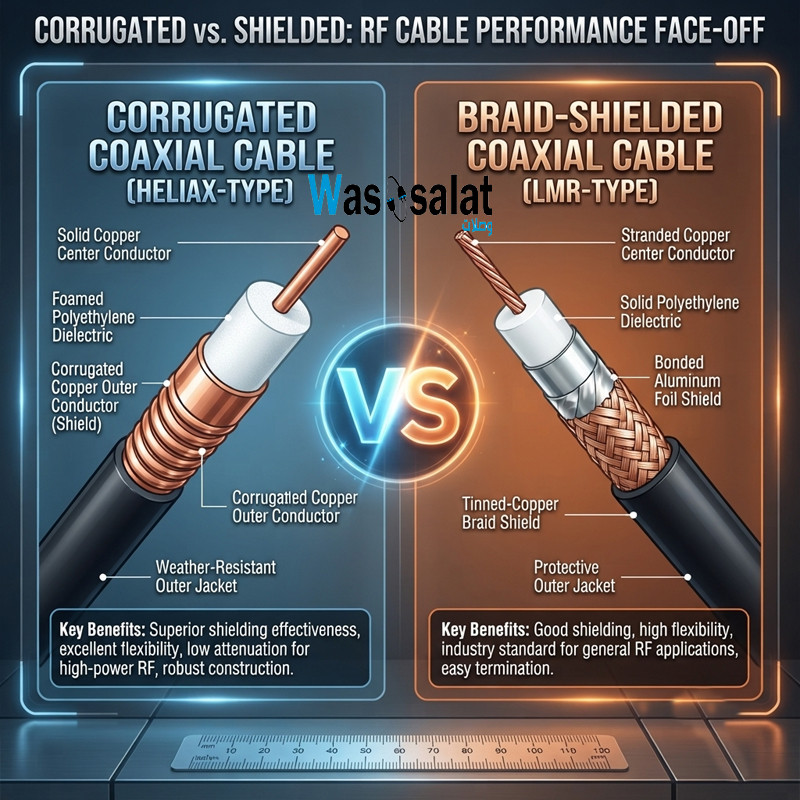
Corrugated Coaxial Cable
?
- Inner Conductor: Solid copper or copper-clad aluminum
- Dielectric: Foam polyethylene (low loss)
- Outer Conductor: Corrugated copper tube (100% coverage)
- Jacket: UV-resistant polyethylene (PE)
The corrugated outer conductor provides superior shielding and lowest possible loss. The corrugations allow the cable to bend despite the rigid metal.
Shielded Coaxial Cable
?️
- Inner Conductor: Solid or stranded copper
- Dielectric: Foam or solid polyethylene
- Outer Conductor: Foil and/or braided copper
- Jacket: PVC, PE, or LSZH
The foil and braid layers provide effective shielding with excellent flexibility. Braid coverage typically ranges from 60-95%.
Performance Comparison
Attenuation (Signal Loss)
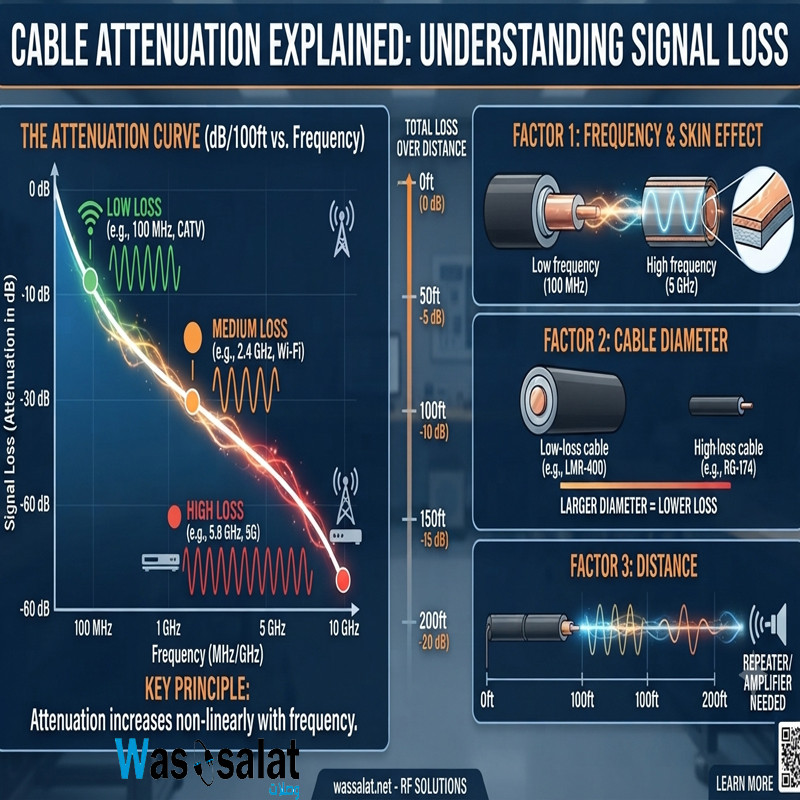
Corrugated cables have significantly lower attenuation than shielded cables, especially at higher frequencies:
| Cable Type | @ 100 MHz | @ 400 MHz | @ 900 MHz | @ 2.4 GHz |
|---|---|---|---|---|
| RG6 (75Ω) | 2.5 dB | 5.2 dB | 8.0 dB | 13.5 dB |
| LMR-400 (50Ω) | 1.5 dB | 3.0 dB | 4.5 dB | 7.5 dB |
| HELIAX® 1/2" (50Ω) | 0.8 dB | 1.6 dB | 2.5 dB | 4.2 dB |
| HELIAX® 7/8" (50Ω) | 0.4 dB | 0.8 dB | 1.3 dB | 2.2 dB |
? Key Finding: At 900 MHz, HELIAX® 1/2" has 44% lower loss than LMR-400 and 69% lower loss than RG6. This allows much longer cable runs without amplifiers.
Shielding Effectiveness
| Cable Type | Coverage | Shielding (dB) |
|---|---|---|
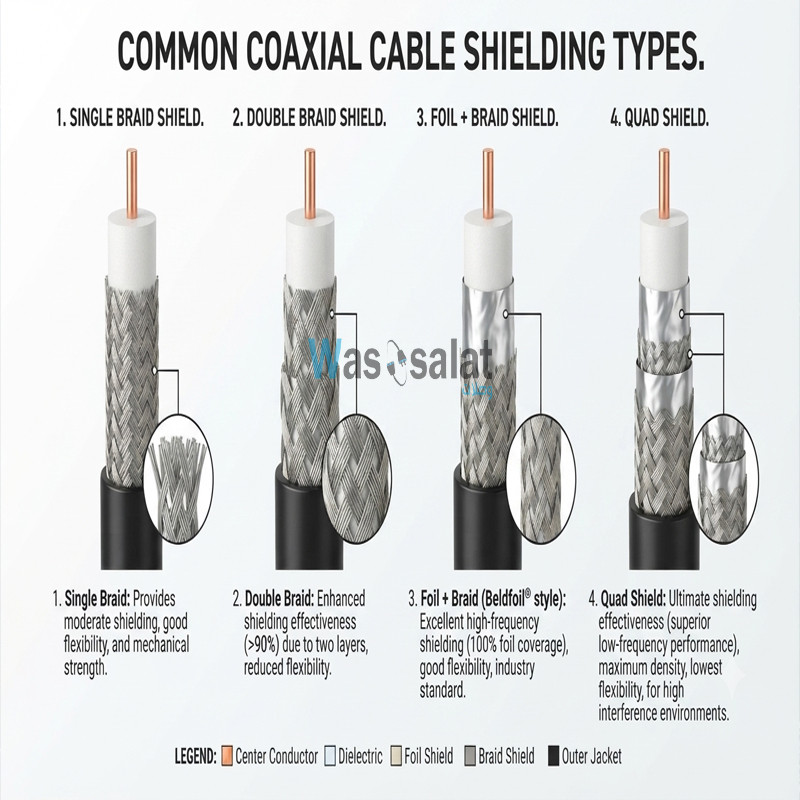
| Single Shield (RG58) | 60-80% | ~60 dB |
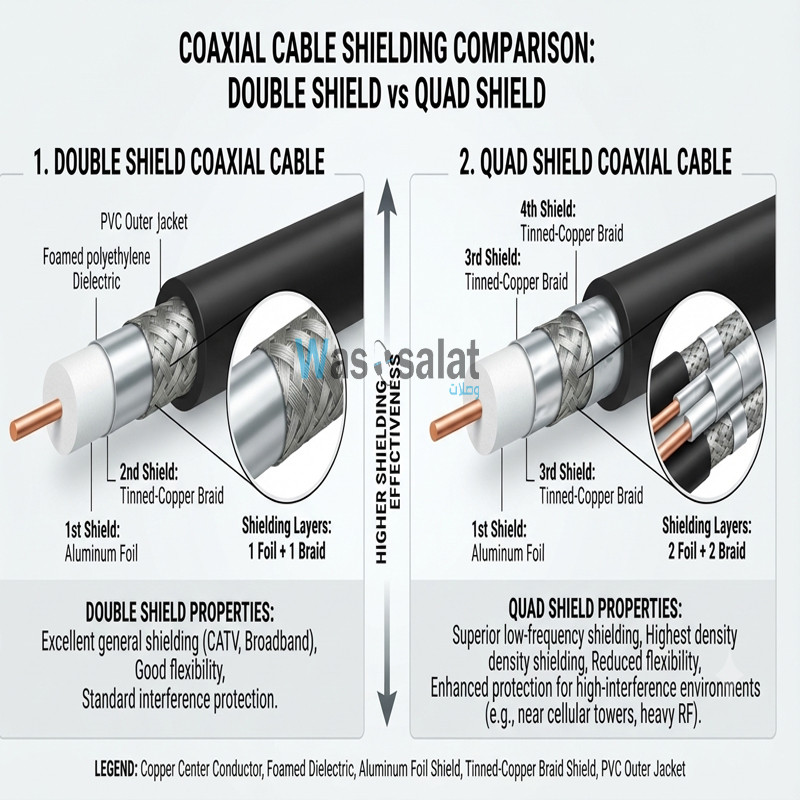
| Dual Shield (RG6) | ≈100% | ~85 dB |
| Quad Shield (RG6Q) | ≈100% | ~110 dB |
| Double Braid (LMR-400) | ≈100% | ~90 dB |
| Corrugated (HELIAX®) | 100% | >120 dB |
Power Handling
| Cable Type | Power @ 900 MHz | Power @ 2.4 GHz |
|---|---|---|
| RG6 (75Ω) | ~50 W | ~25 W |
| LMR-400 (50Ω) | ~200 W | ~100 W |
| HELIAX® 1/2" | ~500 W | ~300 W |
| HELIAX® 7/8" | ~1200 W | ~700 W |
Applications Guide
When to Use Corrugated Coaxial Cable
- ✅ Cellular Base Stations – High-power, low-loss feeder cables
- ✅ Broadcast Transmitters – High-power RF transmission
- ✅ Long Cable Runs – Runs exceeding 200 feet
- ✅ High-Power Transmitters – >100W continuous power
- ✅ Critical Infrastructure – Highest reliability required
- ✅ Outdoor Installations – Weather-resistant construction
- ✅ Remote Radio Head (RRH) Feeds – Cellular and 5G
? Recommended: For cellular base stations and high-power broadcast applications, corrugated cables like HELIAX® are the industry standard. They provide the lowest loss and highest reliability.
When to Use Shielded Coaxial Cable
- ✅ WiFi Antenna Feeds – LMR-400 is ideal for short runs
- ✅ TV/Satellite Installations – RG6 is the standard
- ✅ General RF Connections – Lab and test equipment
- ✅ Short to Medium Runs – Under 150-200 feet
- ✅ Flexible Installations – Tight bends and tight spaces
- ✅ Cost-Sensitive Projects – Budget-conscious installations
- ✅ DIY and Home Installations – Easier to install
Cost Comparison
| Cable Type | Cost (per 100 ft) | Cost Factor |
|---|---|---|
| RG6 (75Ω) | ~$30-50 | 1x |
| RG11 (75Ω) | ~$60-100 | ~2x |
| LMR-400 (50Ω) | ~$80-120 | ~3x |
| LMR-600 (50Ω) | ~$120-180 | ~4x |
| HELIAX® 1/2" | ~$200-300 | ~6-8x |
| HELIAX® 7/8" | ~$400-600 | ~12-15x |
⚠️ Note: Corrugated cables cost significantly more than shielded cables. However, the cost difference is often justified by the superior performance, lower loss, and longer run capability.
Installation Considerations
Corrugated Cable Installation
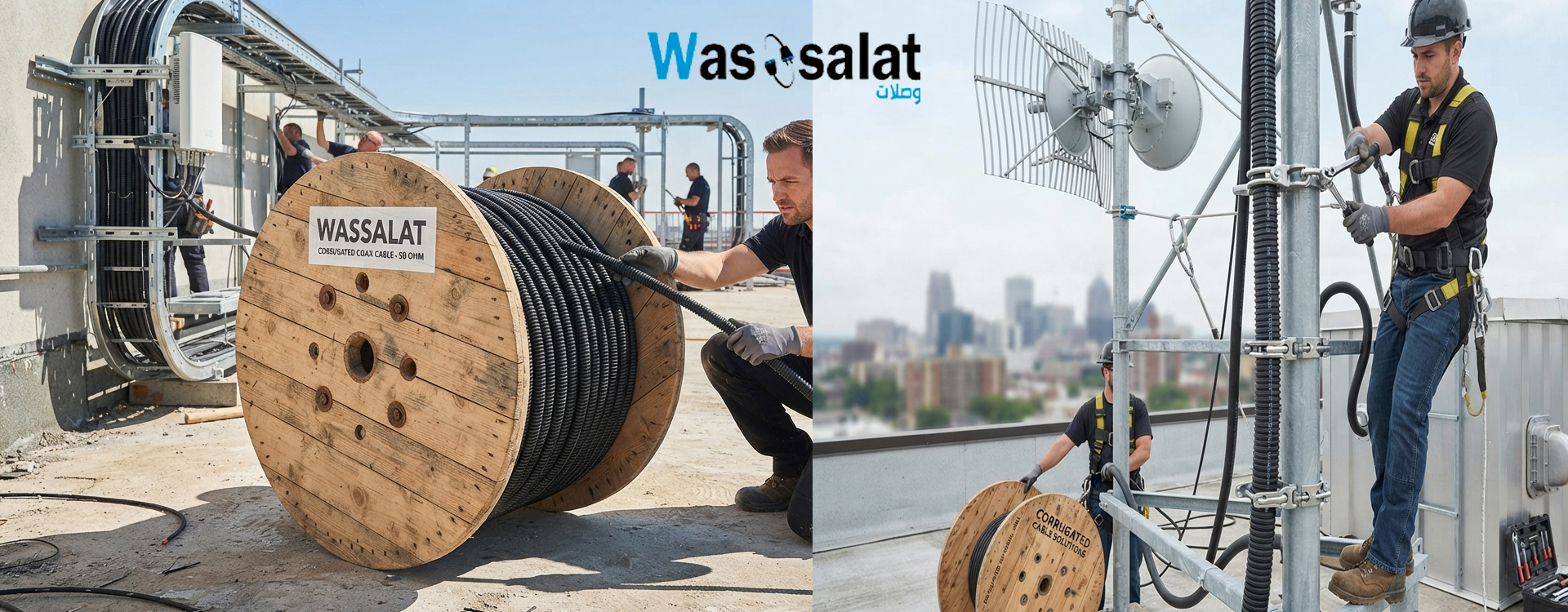
- ⚠️ Special tools required – Connector installation requires specific tooling
- ⚠️ Careful handling – Corrugated conductor can be damaged if over-bent
- ⚠️ Minimum bend radius – Typically 4-6" for 1/2" cable
- ⚠️ Heavier – Requires proper support and mounting
- ✅ Weatherproof – PE jacket and sealed connectors
- ✅ Durable – Resists crushing and physical damage
Shielded Cable Installation
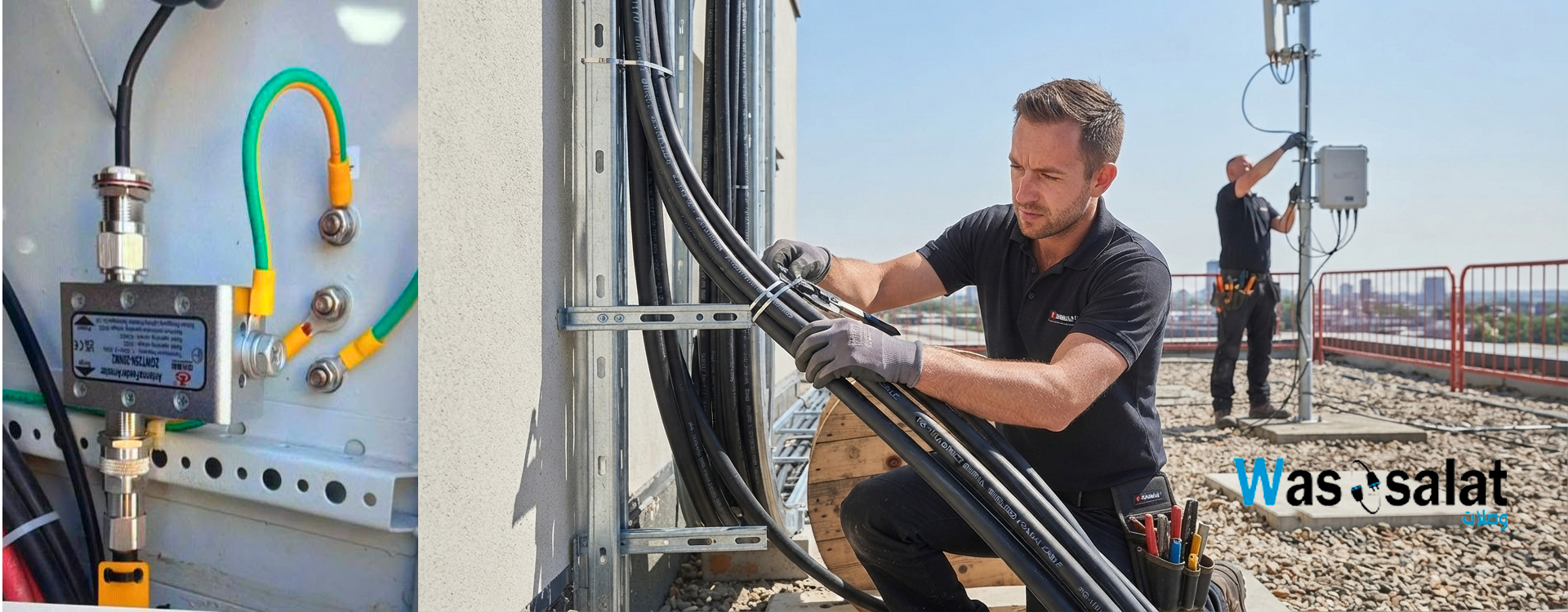
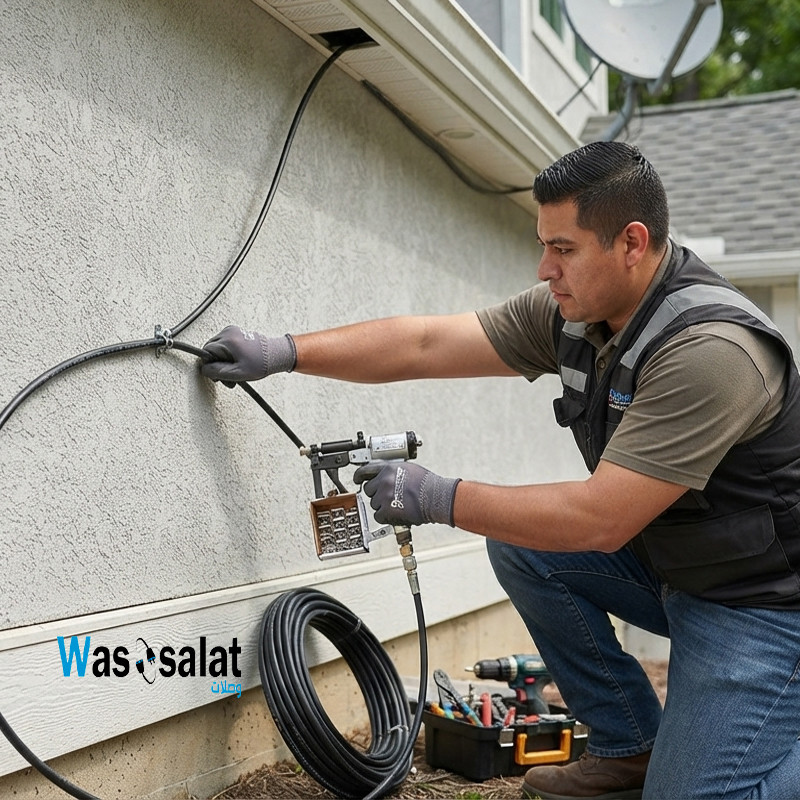
- ✅ Standard tools – Stripper, crimp/compression tool
- ✅ Flexible – Easy to route in tight spaces
- ✅ Lightweight – Easy to handle and install
- ✅ Standard connectors – Widely available and easy to install
- ⚠️ Moisture sensitive – Outdoor use requires weatherproofing
- ⚠️ Limited run length – Signal loss limits distance
Frequently Asked Questions (FAQ)
1. What is the main difference between corrugated and shielded coaxial cable?
The main difference is the outer conductor design. Corrugated cables use a rigid, corrugated metal tube (100% coverage, lowest loss). Shielded cables use flexible foil and braid layers (good shielding, better flexibility).
2. When should I use corrugated coaxial cable?
Use corrugated cables for high-power RF, cellular base stations, broadcast transmitters, long runs (>200 feet), and applications where ultra-low loss and maximum shielding are critical.
3. When should I use shielded coaxial cable?
Use shielded cables for WiFi, TV, satellite, general RF, short to medium runs (<200 feet), and applications where flexibility and cost are important.
4. Which cable has lower loss?
Corrugated cables have significantly lower loss than shielded cables. At 900 MHz, HELIAX® 1/2" has 44% lower loss than LMR-400 and 69% lower loss than RG6.
5. Which cable is more expensive?
Corrugated cables are much more expensive. HELIAX® 1/2" costs about 6-8x more than RG6 and 2-3x more than LMR-400 per foot.
6. Can I use corrugated cable indoors?
Yes, but corrugated cables are stiffer and harder to route in tight spaces. They are more commonly used outdoors or in dedicated cable trays.
7. Do I need special connectors for corrugated cable?
Yes. Corrugated cables require special clamp-type connectors and specific installation tools. Standard F-Type or N-Type crimp connectors will not work.
8. What is the bend radius for corrugated cable?
For HELIAX® 1/2", the minimum bend radius is typically 4-6 inches. For larger sizes like 7/8", it's 8-12 inches. Always check manufacturer specifications.
9. Is HELIAX® the only corrugated cable brand?
HELIAX® is the most well-known brand from Andrew/CommScope. Other manufacturers like RFS, Times Microwave, and others also produce corrugated coaxial cables.
10. What's the maximum length for each cable type?
Corrugated cables can run 500+ feet with acceptable signal loss. Shielded cables are typically limited to 150-300 feet depending on frequency and cable type.
? Related Articles
- Complete Guide to Coaxial Cables
- Shielding Types in Coaxial Cables
- Cable Attenuation Explained
- LMR-400 vs RG58
- Satellite Coaxial Cables
- Outdoor Coaxial Cable
? Need Coaxial Cables for Your Installation?
We stock both corrugated (HELIAX®) and shielded (RG6, RG11, LMR) cables. Our team can help you choose the right cable for your application.
Last Updated: July 2026
© 2026 Wassalat. All rights reserved.
Posted in:
Coaxial Cables
Related posts
-
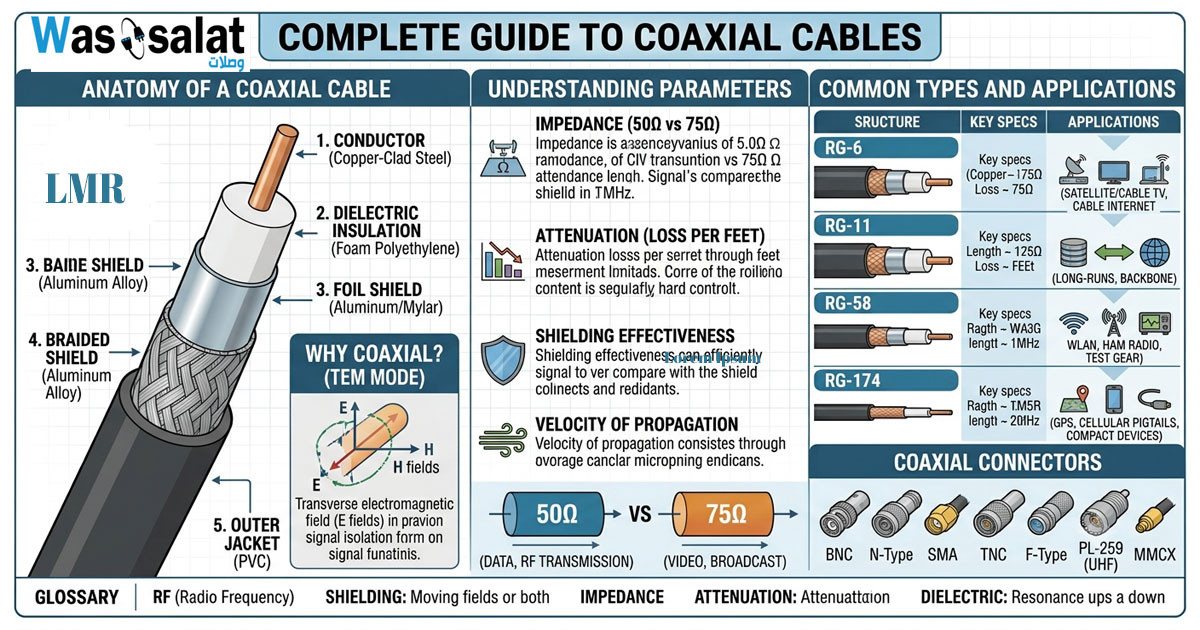 Complete Guide to Coaxial Cables
Everything you need to know about RG-6, LMR-400, impedance, connectors & troubleshooting.Read more
Complete Guide to Coaxial Cables
Everything you need to know about RG-6, LMR-400, impedance, connectors & troubleshooting.Read more -
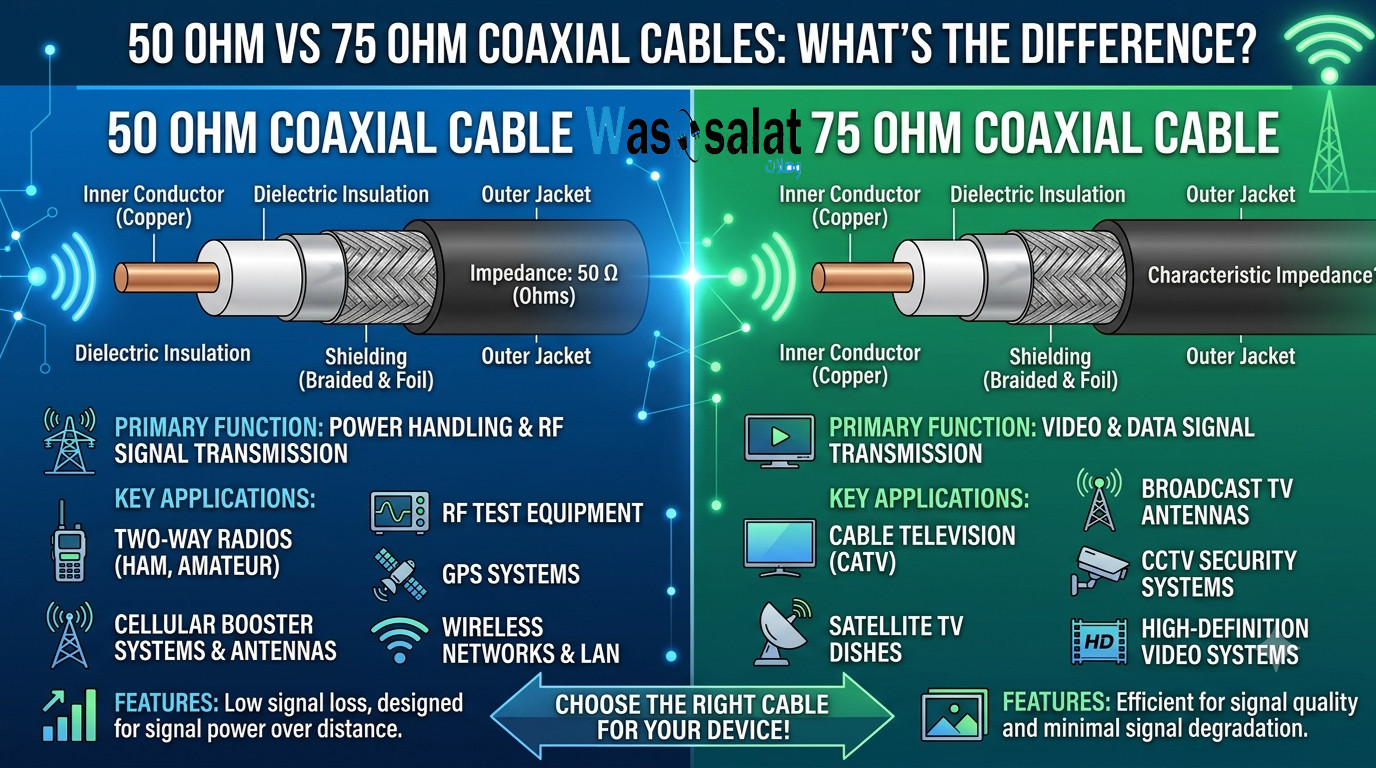 50 Ohm vs 75 Ohm Coaxial Cables: What's the Difference?
Learn the key differences between 50Ω and 75Ω coaxial cables. Find out which impedance you need for WiFi, TV, CCTV,...Read more
50 Ohm vs 75 Ohm Coaxial Cables: What's the Difference?
Learn the key differences between 50Ω and 75Ω coaxial cables. Find out which impedance you need for WiFi, TV, CCTV,...Read more -
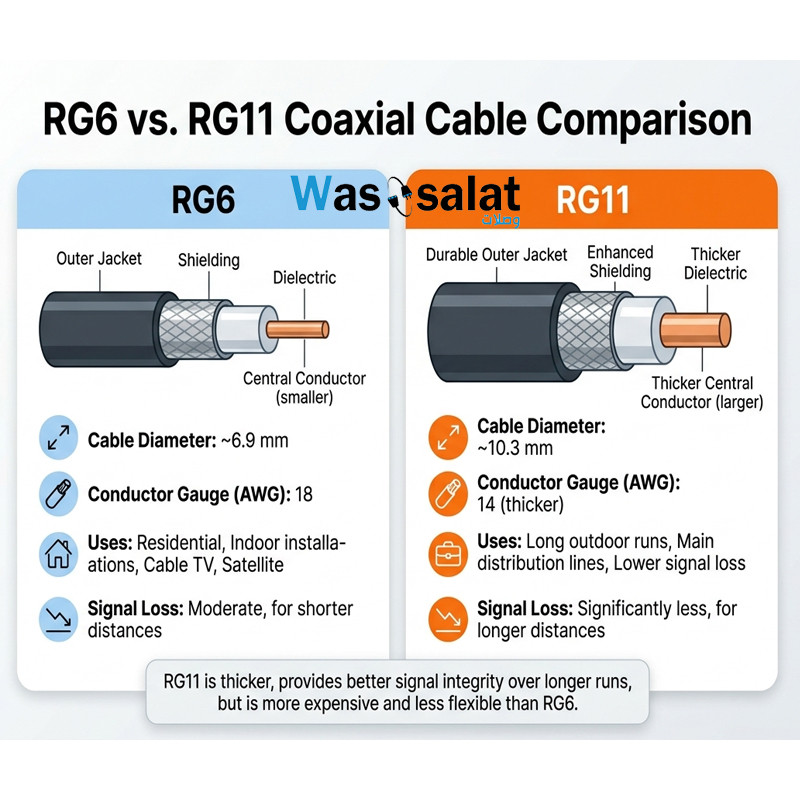 RG6 vs RG11 Coaxial Cables: Which One Do You Need?
Compare RG6 and RG11 coaxial cables. Learn the differences in performance, distance, cost, and when to use each for...Read more
RG6 vs RG11 Coaxial Cables: Which One Do You Need?
Compare RG6 and RG11 coaxial cables. Learn the differences in performance, distance, cost, and when to use each for...Read more -
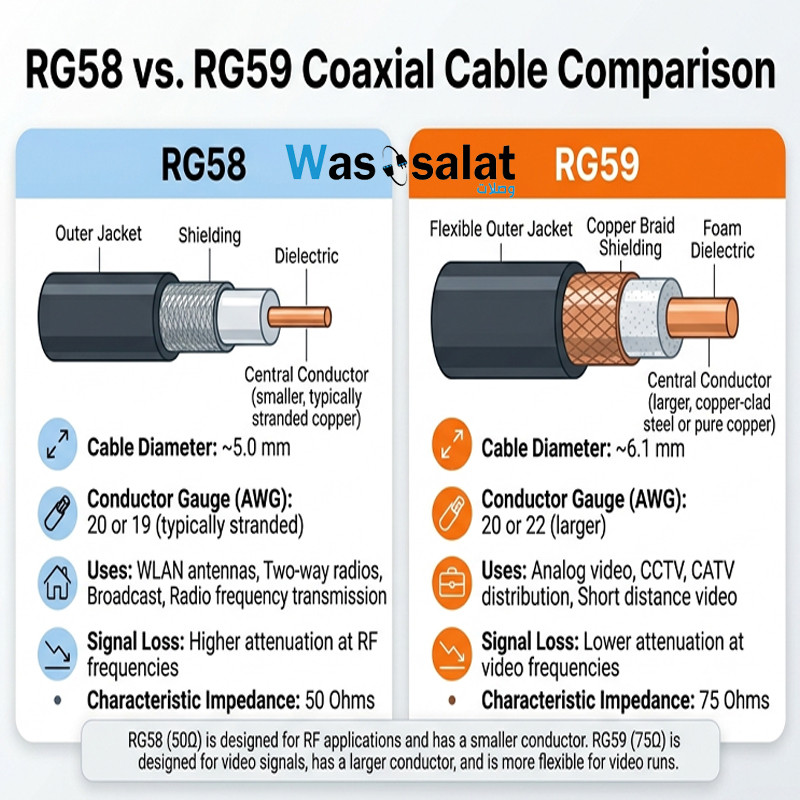 RG58 vs RG59 Coaxial Cables: What's the Difference?
Compare RG58 and RG59 coaxial cables. Learn the critical impedance difference, applications for RF vs video, and...Read more
RG58 vs RG59 Coaxial Cables: What's the Difference?
Compare RG58 and RG59 coaxial cables. Learn the critical impedance difference, applications for RF vs video, and...Read more -
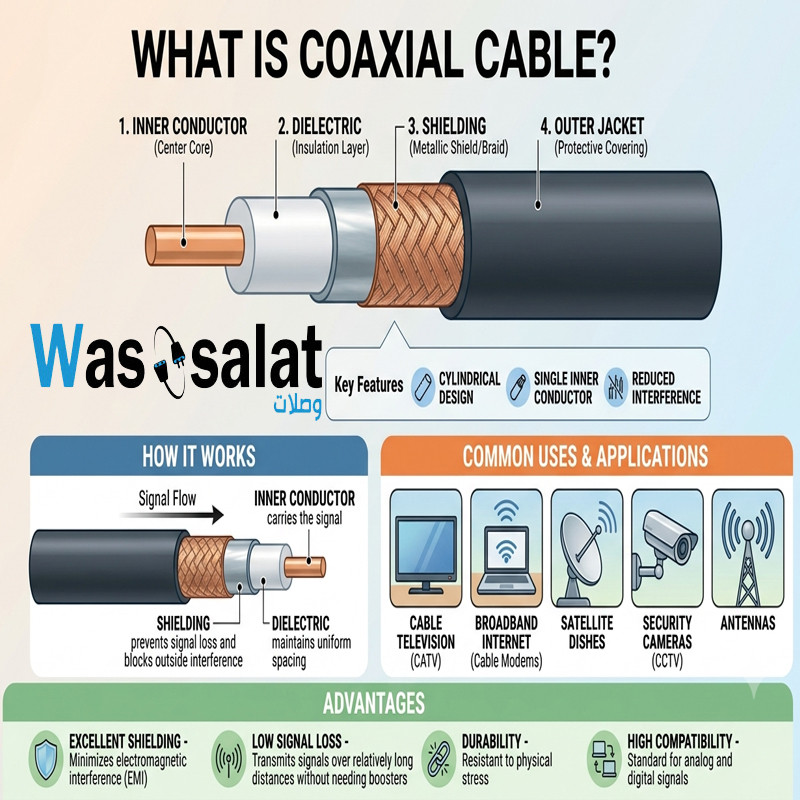 What Is a Coaxial Cable? The Complete Beginner's Guide
Learn what coaxial cables are, how they work, their construction, types, and applications. The beginner's guide to...Read more
What Is a Coaxial Cable? The Complete Beginner's Guide
Learn what coaxial cables are, how they work, their construction, types, and applications. The beginner's guide to...Read more
Latest posts
-
 Waterproof Coaxial Cable: The Complete GuideRead more
 -
 Testing Coaxial Cable: The Complete GuideRead more
This comprehensive guide covers everything you need to know about testing coaxial cable—from simple continuity checks...
-
 Corrugated Coaxial Cable vs Shielded Coaxial Cable: Complete ComparisonRead more
This comprehensive guide compares both technologies—explaining the differences in construction, performance,...
-
 Installing Coaxial Cable: The Complete GuideRead more
This comprehensive guide compares double shield and quad shield coaxial cables—explaining the differences in...
-
 Double Shield vs Quad Shield: Which Coaxial Cable Should You Choose?Read more
This comprehensive guide compares double shield and quad shield coaxial cables—explaining the differences in...
-
 Shielding Types in Coaxial Cables: Complete GuideRead more
This comprehensive guide explains everything you need to know about shielding types—from single shield to quad...
-
 Cable Attenuation Explained: Understanding Signal LossRead more
This comprehensive guide explains everything you need to know about cable attenuation—what it is, what causes it, how...
-
 Outdoor Coaxial Cable: Complete Guide & Selection TipsRead more
Choose the right outdoor coaxial cable for your installation. Compare TZC-500/32 vs TZC-500/97, learn about PE...
-
 LMR-400 vs RG58: Which Coaxial Cable Should You Choose?Read more
Compare LMR-400 vs RG58 coaxial cables. Learn the differences in signal loss, construction, flexibility, and...
-
 Coax Cable Connectors: Complete Guide to F-Type, BNC, N-Type, SMARead more
Learn about coaxial cable connectors—F-Type, BNC, N-Type, SMA, TNC, and UHF. Compare impedances, frequencies, and...
Leave a comment